🦴 Quick Facts from Prof. Dr. Göçer
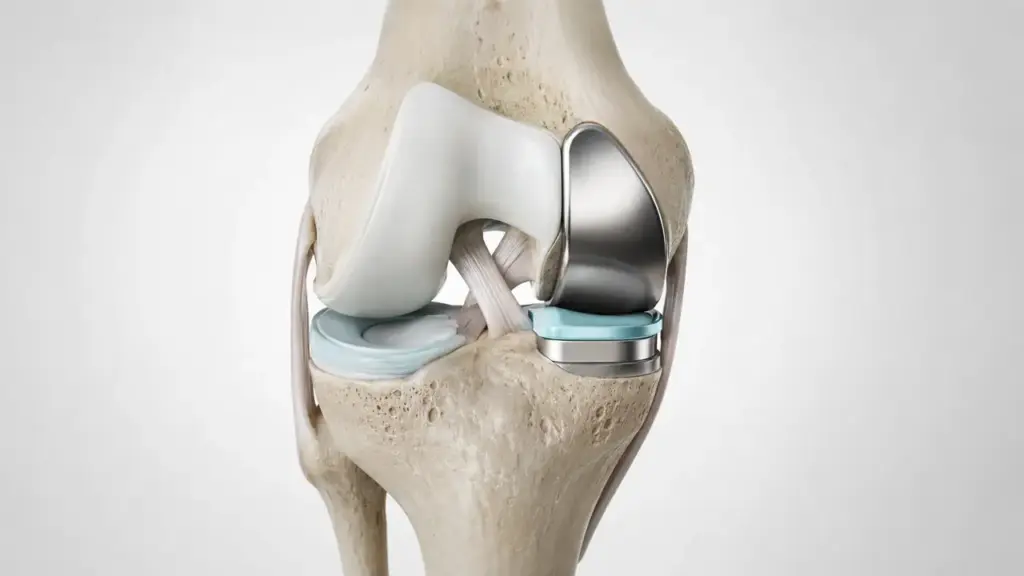
- Partial knee replacement is a surgical procedure designed for single-compartment involvement, in which only the worn-out portion of the knee is replaced.
- It is preferred for suitable patients whose osteoarthritis is limited to a single compartment of the knee and whose anterior cruciate ligament is intact.
- Compared to total knee replacement, it offers a smaller incision, less blood loss, a shorter hospital stay, and faster recovery.
- Because healthy cartilage and ligaments are preserved, many patients feel that their knee moves more naturally.
Knee osteoarthritis does not always affect the entire joint; sometimes, the wear and tear is limited to only one compartment of the knee.Partial knee replacement is a surgical procedure used in these cases, where only the damaged compartment is replaced with artificial components, while healthy tissues are preserved. It is also known as a unicompartmental (single-compartment) knee replacement.
What Is a Partial Knee Replacement?
A partial knee replacement involves replacing only the damaged compartment of the knee joint with artificial components. The knee is divided into three compartments: the medial (inner), lateral (outer), and patellofemoral (knee cap-thigh) compartments. If osteoarthritis is limited to only one of these compartments, only that compartment is replaced rather than the entire joint.
The most important feature of this approach is the preservation of healthy cartilage and, in particular, the cruciate ligaments. Preserving the ligaments allows the knee to largely maintain its natural range of motion, which helps the knee feel more “natural” for many patients.
Who Is a Candidate for Partial Knee Replacement?
Partial knee replacement is not suitable for every patient with osteoarthritis; it is preferred for those who meet specific criteria. The general eligibility criteria are as follows:
- Unicompartmental involvement: Osteoarthritis is limited to only one compartment of the knee.
- Intact cruciate ligaments: In particular, the anterior cruciate ligament (ACL) must be intact.
- Correctable alignment: There must be no significant, fixed misalignment along the leg axis.
- Adequate range of motion: The knee must be able to bend and straighten to a reasonable extent.
According to Prof. Dr. Hasan Göçer, the key to success in partial knee replacement is proper patient selection; in patients where osteoarthritis is truly limited to a single compartment and the ligaments are intact, this method can offer both faster recovery and a more natural knee sensation.
The Difference Between Partial Knee Replacement and Total Knee Replacement
The fundamental difference between the two methods is the extent of the area being replaced. The table below summarizes the general differences; however, which method is appropriate is determined on a case-by-case basis for each patient.
| Feature | Partial Knee Replacement | Total Knee Replacement |
|---|---|---|
| Area Replaced | Only the damaged segment | The entire joint |
| Incision Size | Smaller | Larger |
| Ligament Preservation | Cruciate ligaments are preserved | Some ligaments may be removed |
| Recovery Time | Generally faster | May take longer |
| Suitability | Single-compartment involvement | Widespread (multicompartment) involvement |
While a partial knee replacement offers less tissue damage and faster healing in suitable patients, a total knee replacement is a more appropriate option when osteoarthritis affects multiple compartments of the knee. The decision is made based on imaging and examination findings.
How Is Partial Knee Replacement Surgery Performed?
Partial knee replacement surgery is performed under general or regional anesthesia using a smaller incision than that required for a total knee replacement. Since the procedure involves replacing only the damaged segment, it requires less intervention in the surrounding tissues.
- Anesthesia: The anesthesia method appropriate for the patient is administered.
- Access: The damaged segment is accessed through a small incision.
- Surface Preparation: Only the surfaces within the worn-out segment are carefully cleaned.
- Prosthesis Placement: Components of the appropriate size are placed in the relevant segment.
- Closure: The incision is closed while monitoring movement and stability.
Thanks to the smaller incision and preserved tissues, postoperative pain and blood loss are generally less than with a total prosthesis. This can shorten the hospital stay and recovery period.
Clinical Assessment by Prof. Dr. Hasan Göçer
“In my clinical practice, I emphasize that the greatest advantage of a partial knee replacement is the preservation of healthy tissue. In a properly selected patient, leaving the knee’s own ligaments and healthy cartilage in place ensures both faster recovery and a more natural sense of movement.”
Prof. Dr. Hasan Göçer — Orthopedic and Traumatology Specialist
The practical importance of this approach is based on the principle of “as much surgery as necessary.” In a knee with limited osteoarthritis, replacing only the damaged segment rather than the entire joint ensures the preservation of healthy structures. However, this is only possible in suitable patients; if the patient is not properly selected, the outcome may not be as desired.
Partial Knee Replacement Recovery Process
The recovery process for a partial knee replacement is generally faster than that for a total knee replacement. Thanks to the small incision and preserved tissues, many patients can get out of bed and begin walking with assistance early on.
- Early phase (first few days): Getting up and walking with assistance begins under the supervision of a physical therapist.
- First weeks: Many patients can progress to independent walking during this period; exercises continue.
- First months: A gradual return to daily activities is achieved.
- Advanced stage: Knee strength and range of motion are largely regained.
The rate of recovery depends on the patient’s overall condition, muscle strength, and adherence to physical therapy. Regular exercise and adherence to the physician’s recommendations are essential to fully benefit from the advantages of a partial prosthesis.
From Surgery to Recovery: How Does the Process Proceed?
| Stage | Time | What Happens? |
|---|---|---|
| Evaluation | Pre-surgery | The extent of the condition (whether it is limited to a single compartment) and the ligaments are evaluated |
| Surgery | Day of the procedure | Only the damaged segment is replaced with a prosthesis through a small incision |
| Early Recovery | First few days | Standing and walking begin with physical therapy |
| Physical Therapy | Weeks | Mobility and muscle strength are rapidly regained |
| Follow-up | Long-term | The condition of the prosthesis and the knee is regularly monitored |
Evaluation and Surgery: The extent of osteoarthritis (whether limited to a single compartment) and the condition of the ligaments are assessed; if appropriate, the prosthesis is implanted via a small incision.
Recovery and Physical Therapy: Walking begins early on; mobility and strength are rapidly regained thanks to the preserved tissues.
Follow-up: The condition of the prosthesis and the knee is monitored through regular follow-up visits over the long term.
Frequently Asked Questions
When is a partial knee replacement preferred?
It is preferred in patients where osteoarthritis is limited to only one compartment of the knee, the anterior cruciate ligament is intact, and the alignment is correctable. In cases of widespread (multi-compartment) osteoarthritis, a total knee replacement is more appropriate. The decision is made based on physical examination and imaging.
Which is better: a partial knee replacement or a total knee replacement?
It cannot be definitively stated that one is “better” than the other; suitability depends on the patient’s condition. While a partial replacement offers faster recovery in cases of single-compartment osteoarthritis, a total replacement is necessary for widespread osteoarthritis. The most appropriate option is determined through an individualized assessment.
How long does recovery take after a partial knee replacement?
Recovery after a partial knee replacement is generally faster than after a total knee replacement. Many patients begin walking with assistance early on and gradually return to their daily activities within weeks. The duration varies depending on the patient’s condition and adherence to physical therapy.
How long does a partial knee replacement last?
Partial knee replacements can function effectively for many years in suitable patients. Their lifespan varies depending on the patient’s age, weight, and activity level. If necessary, a partial knee replacement can be converted to a total knee replacement in the future. Regular checkups are important for monitoring the condition of the prosthesis.
Conclusion
A partial knee replacement is an effective method for relieving pain while preserving healthy tissue in suitable patients whose osteoarthritis is limited to only one segment of the knee. Compared to a total knee replacement, it involves a smaller incision and offers faster recovery; however, its success depends largely on proper patient selection. Which method is appropriate must be evaluated individually for each patient.
You can begin the examination process to assess your personal situation regarding partial knee replacement. Prof. Dr. Hasan Göçer evaluates each patient’s clinical case individually to determine the most appropriate treatment options.
Sources
- NCBI/PMC, “Unicompartmental knee replacement: controversies and technical considerations,” 2024 — https://www.ncbi.nlm.nih.gov/pmc/articles/PMC11064323/
- OrthoVirginia, “Partial knee replacement” — https://www.orthovirginia.com/partial-knee-replacement/
- Physiopedia, “Partial Knee Replacement” — https://www.physio-pedia.com/Partial_Knee_Replacement