👨⚕️ Prof. Dr. Hasan Göçer📅 21 Temmuz 2026🕑 9 dk okuma
🦴 Quick Facts from Prof. Dr. Göçer
Benign bone tumors are much more common than malignant ones and do not spread to other parts of the body.
The most common type is osteochondroma; it typically occurs between the ages of 10 and 30 and is found in long bones.
Most tumors that do not cause symptoms do not require treatment; they can be monitored with imaging every 6 months.
Pain that worsens at night is typical of osteoid osteoma and is significantly relieved by NSAID pain relievers.
The vast majority of bone masses are not cancerous. A benign bone tumor, is a mass formed by the limited and controlled proliferation of cells in bone tissue that does not spread to surrounding tissues or distant organs. It is usually not life-threatening, and some cases require no treatment at all.
What Is a Benign Bone Tumor?
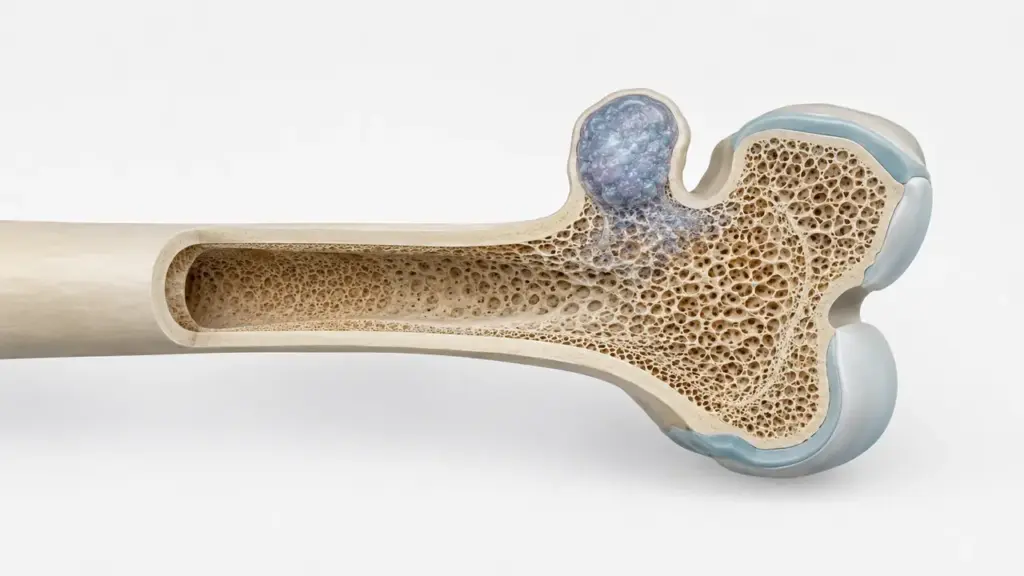
A benign bone tumor is a mass formed by the abnormal but limited proliferation of cells that make up bone (bone, cartilage, or connective tissue). These tumors have distinct borders, grow slowly, and do not invade surrounding tissues.
Unlike malignant tumors, these masses do not spread to other organs via the bloodstream or lymphatic system. Therefore, in most cases, treatment is aimed not so much at removing the mass as at alleviating symptoms when necessary and preventing rare complications.
Symptoms of Benign Bone Tumors
Some of these tumors cause no symptoms and are discovered incidentally on an X-ray taken for another reason. When symptoms do occur, the most common findings are as follows. Symptoms of benign bone tumors vary depending on the type and location of the mass:
Pain: In some types, particularly osteoid osteoma, pain that worsens at night and is relieved by painkillers may occur.
A firm, palpable swelling: Tumors close to the bone’s surface may form a protrusion that can be felt upon touch.
Limited movement: Masses near a joint may restrict tendon or joint movement.
Signs of compression: Tumors adjacent to nerves or blood vessels may cause symptoms such as numbness or tingling.
Pathological fracture: In some tumors that weaken the bone, a fracture may occur with even minor stress.
According to Prof. Dr. Hasan Göçer, whether a benign tumor causes symptoms depends largely on its location; even a small mass located near a joint or nerve may cause more symptoms than a large but asymptomatic mass.
What Causes Benign Bone Tumors?
The exact cause of most of these tumors is unknown. Some arise in connection with the growth plate during childhood and adolescence, when bone development is ongoing. For example, osteochondroma—the most common type—is more prevalent in children and young adults because it develops around the growth plate of long bones.
In some cases, genetic predisposition plays a role. In certain hereditary conditions where multiple cartilage-derived tumors occur together (such as Ollier disease and Maffucci syndrome), the risk of malignancy is slightly higher compared to those with a single tumor; however, this remains rare.
Types of Benign Bone Tumors
There are many types of benign tumors that originate in bone. The table below summarizes the most common types, their typical age of onset, and the general management approach.
Type
Origin / Location
Typical Age
General Management
Osteochondroma
Cartilage-covered protrusion on the bone surface
10–30
Observation if asymptomatic
Enchondroma
Cartilage within the bone marrow cavity
10–30
Observation or curettage
Osteoid osteoma
Long bones, small and painful
10–20
Pain management / intervention
Chondroblastoma
Bone ends, near joints
10–20
Usually surgery
Giant cell tumor
Bone ends; may extend into surrounding tissue
20–40
Surgery
Among these types, osteochondroma is the most common and is often noticed as a painless, palpable lump. Accurate identification of the type determines whether observation or surgery is indicated.
Clinical Assessment by Prof. Dr. Hasan Göçer
“In my clinical practice, I have observed that most patients diagnosed with a benign bone tumor do not require surgery, and can be safely monitored with regular follow-ups. The critical point here is to confirm that the tumor is truly benign using the correct method and to avoid unnecessary surgery.”
Prof. Dr. Hasan Göçer — Orthopedic and Traumatology Specialist
This approach is of great importance from the patient’s perspective. Rather than immediately deciding on surgery for a tumor that is asymptomatic and shows no tendency to grow, monitoring with scheduled imaging is often the more appropriate option. This approach not only avoids unnecessary surgical risks but also allows for the safe monitoring of the tumor’s progression.
Treatment of Benign Bone Tumors
The decision regarding treatment is made on an individual basis, depending on the tumor’s type, size, location, and whether it is causing symptoms. There is no single standard approach; while some patients require no intervention, surgery may be appropriate for others.
Follow-up
This is the most commonly preferred approach for tumors that do not cause symptoms and are not growing. The patient is monitored at regular intervals using X-rays or other imaging methods. This helps avoid unnecessary interventions.
Pain Management with Medication
In certain painful types, such as osteoid osteoma, pain can initially be managed with nonsteroidal anti-inflammatory drugs (NSAIDs). This approach reduces the need for additional interventions in some cases.
Surgical Treatment
Surgery is considered for tumors that cause pain, limited mobility, nerve or vascular compression, or a risk of fracture. The most commonly used method involves scraping out the tumor (curettage) and filling the resulting cavity with a bone graft or bone cement.
Prof. Dr. Göçer emphasizes that in clinical practice, the choice of treatment must be made by evaluating the patient’s age, the type of tumor, and the patient’s symptoms together. Even the same type of tumor may require a different approach in different patients.
Benign Bone Tumor Surgery
Surgery for a benign bone tumor, involves the removal or scraping of the mass and the repair of the resulting cavity. The scope of the procedure varies depending on the tumor’s location and size. In most cases, the goal is both to alleviate symptoms and to prevent complications such as fractures.
Postoperative recovery is generally shorter than for malignant tumor surgeries and does not require additional treatment (such as chemotherapy). However, the recovery time following surgery for a benign bone tumor varies from person to person depending on the tumor’s size and the type of surgery performed; physical therapy and regular follow-up visits are part of the process.
From Diagnosis to Recovery: How Does the Process Unfold?
Stage
Time
What Happens?
Initial Examination
Day 1
Physical examination; duration of symptoms is assessed; X-ray is ordered
Imaging & Planning
Weeks 1–2
Tumor type and margins are assessed via MRI/CT
Decision
Weeks 2–3
Determination of whether observation or surgery is required; a biopsy is scheduled if necessary
Follow-up or Surgery
Depending on the situation
Follow-up for asymptomatic tumors; curettage/surgery when indicated
Follow-up
Varies
Regular follow-up visits are conducted to ensure there is no recurrence
Initial Examination: The duration of symptoms, the nature of the pain, and how it affects daily life are assessed. An X-ray at this stage determines the direction of subsequent steps.
Imaging and Decision: MRI and CT scans clarify the tumor type and its relationship with adjacent structures. Based on these findings, a decision is made regarding whether to opt for observation or surgery.
Follow-up or Surgery: Asymptomatic tumors are monitored with regular checkups, while those causing symptoms or posing a risk are treated surgically.
Follow-up: In the postoperative period, follow-up examinations are conducted at regular intervals to prevent recurrence and confirm healing.
Frequently Asked Questions
Why are benign tumors removed?
The exact cause of most benign bone tumors is unknown. Some develop in connection with bone growth during childhood, while genetic predisposition plays a role in others. In many patients, no specific cause can be identified.
Do benign bone tumors cause pain?
Some types are painless and are discovered incidentally. However, in certain types, such as osteoid osteoma, pain—which is often more pronounced at night—may occur. The presence and severity of pain depend on the type and location of the tumor.
Do benign bone tumors go away on their own?
Some types, such as non-ossifying fibroma—which is commonly seen in children—may regress on their own over time. However, this is not true for all types. Only a doctor’s evaluation and regular follow-up can determine the course of a tumor.
Are benign tumors dangerous?
Since benign tumors do not spread, they generally do not pose a life-threatening risk. However, they can weaken the bone, leading to fractures, or put pressure on nerves and blood vessels. For this reason, it is important to evaluate tumors that cause symptoms.
Can a benign bone tumor become malignant?
Most benign tumors do not become malignant. However, in some rare cases where multiple cartilage tumors are present together, this risk increases slightly. In these cases, regular follow-up is recommended.
Do benign bone tumors grow?
Some tumors, particularly during childhood and adolescence, may increase in size along with bone growth. A tumor that continues to grow in adulthood, however, should be evaluated more carefully. Growth is monitored through follow-up imaging.
How are benign tumors treated?
Tumors that do not cause symptoms are usually monitored through follow-up. Surgery (typically curettage and bone grafting) is performed for tumors that cause pain, pose a risk of fracture, or exert pressure. The decision regarding treatment is based on the type of tumor and the patient’s condition.
What happens if a benign tumor is not surgically removed?
Many tumors that do not cause symptoms can be safely monitored with regular follow-up without surgery. However, if a tumor that is growing, causing pain, or posing a risk of fracture is left untreated, symptoms may worsen. Therefore, the decision should be made based on the physician’s evaluation.
Conclusion
Benign bone tumors are much more common than malignant ones, do not spread, and usually do not pose a serious threat. While some cases can be monitored without any treatment, surgery may be considered for cases that cause symptoms or carry a risk of fracture. An accurate diagnosis is key to avoiding unnecessary interventions and determining the appropriate approach.
You can begin the examination process to assess your personal situation regarding a benign bone tumor. Prof. Dr. Hasan Göçer evaluates each patient’s clinical presentation individually to determine the appropriate treatment options.
Ortopedi ve Travmatoloji Uzmanı. Kemik ve yumuşak doku tümörleri cerrahisi, diz ve kalça protez cerrahisi ile revizyon protez cerrahisi başta olmak üzere ortopedik travmatoloji ve artroskopi alanlarında hasta odaklı yaklaşımıyla hizmet vermektedir.