? Quick Facts from Prof. Dr. Göçer
- A bone graft is bone tissue taken from the patient’s own bone (autograft) or from a donor (allograft) to fill a void in the bone.
- Curettage is the procedure of scraping out a tumor or cyst from a bone cavity using specialized instruments; the cavity is then typically filled with a bone graft.
- Autografts are most commonly harvested from the hip bone (iliac crest); this is a limb-sparing method that preserves joint function.
- Since the recurrence rate of curettage alone in lesions such as giant cell tumors has been reported to range from 27% to 55% according to studies, adjunctive methods (thermocoagulation or cryotherapy) are frequently used.
A cyst or benign tumor forming in the bone can often be treated by cleaning and repairing only the damaged area, without removing the entire bone. Bone graft and curettage are two complementary steps in this limb-sparing approach: the lesion is scraped away and cleaned, and the resulting cavity is filled with bone tissue.
What Is a Bone Graft?
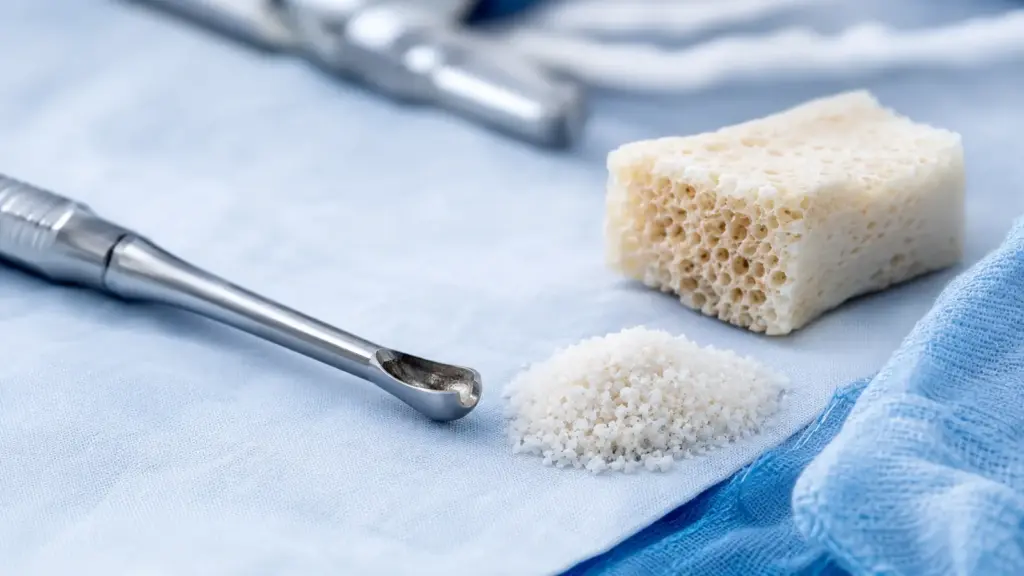
A bone graft is bone tissue placed in an area to repair a void, loss, or nonunion in the bone. The graft both supports the bone by filling the void and prepares the ground for new bone formation. There are two main types of bone grafts, classified by their source.
| Graft Type | Source | Characteristics |
|---|---|---|
| Autograft | The patient’s own bone (mostly from the hip/iliac crest) | Lowest risk of compatibility issues and rejection; high potential for healing |
| Allograft | Processed bone obtained from a donor | Can be used for large defects; requires no additional incision |
According to Prof. Dr. Hasan Göçer, there is no single “right” choice when selecting a graft; the size and location of the defect, as well as the patient’s condition, determine which graft (or combination of grafts) is appropriate. While autografts are preferred for small defects, allografts or mixed grafts may be preferred for large defects.
Bone Graft Treatment
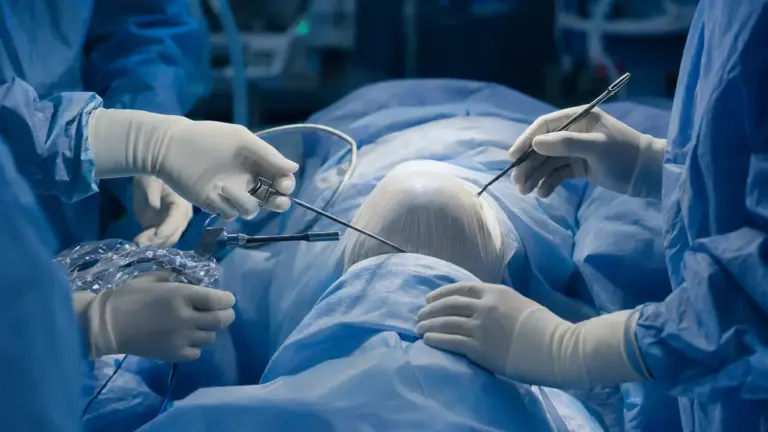
Bone graft treatment, is usually planned in conjunction with curettage. Curettage involves scraping out a tumor or cyst from within the bone; the resulting cavity is then filled with a graft to preserve the bone’s integrity. This process both removes the lesion and supports the bone.
In lesions with a high tendency to recur, such as giant cell tumors, curettage alone may not be sufficient. In such cases, efforts are made to further reduce the risk of recurrence by using a high-speed burr (burr), bone cement (PMMA), or chemical/thermal adjuvants are used to reduce the risk of recurrence. In one study, the recurrence rate with curettage plus grafting alone was reported to range from 27% to 55%.
How Is Bone Grafting Performed?
The grafting procedure is performed in stages after the lesion has been debrided. The goal is to fill the bone defect while preserving the region’s strength and healing potential.
- An appropriate window is created in the bone to access the lesion
- The tumor or cyst is removed by curettage, using a high-speed drill if necessary
- The cavity is irrigated with copious amounts of saline solution
- If necessary, an adjuvant (cement, chemical/thermal method) is applied
- The cavity is filled with an autograft and/or allograft; additional fixation is performed if necessary
Bone Graft Surgery
Bone graft surgery is planned according to the type, size, and location of the lesion. If an autograft is to be used, the graft is most often taken from the hip bone graft via the iliac crest; this area is preferred because it provides an adequate amount of bone and allows the graft to be harvested without causing functional loss.
Prof. Dr. Göçer emphasizes that in his clinical practice, the curettage + graft approach yields good functional results by preserving the bone and joint in suitable lesions; however, if the type of lesion carries a high risk of recurrence, he notes that the treatment plan must be reinforced with adjuvant methods.
Where Is Bone Graft Material Harvested From?
The answer to the question “Where is bone graft material obtained?” depends on the type of graft. In an autograft, bone is harvested from the patient’s own body—most commonly from the hip (iliac crest), and sometimes from around the knee or other areas. In an allograft, the bone is processed donor tissue obtained from regulated bone banks.
Clinical Assessment by Prof. Dr. Hasan Göçer
“In my clinical practice, I view curettage and grafting as one of the most valuable ways to preserve bone and joints. Our goal is to completely remove the lesion while preserving the patient’s own bone structure as much as possible. However, not all lesions are the same; in tumors with a high tendency to recur, simply scraping is not enough—treatment must be reinforced with additional methods. The right method for the right lesion is the key to long-term success.”
Prof. Dr. Hasan Göçer — Orthopedic and Traumatology Specialist
The practical significance of this assessment is that curettage and grafting are not “one-size-fits-all” procedures. The type of lesion and the risk of recurrence directly determine the treatment plan; therefore, accurate diagnosis and planning prior to the procedure are of critical importance.
From Diagnosis to Recovery: How Does the Process Proceed?
| Stage | Time | What Happens? |
|---|---|---|
| Initial Examination | Day 1 | Physical examination and imaging; lesion diagnosis via biopsy if necessary |
| Planning | Weeks 1–2 | A graft and adjuvant plan is developed based on the type and size of the lesion |
| Surgery | Scheduled day | The lesion is removed via curettage; the cavity is filled with a bone graft |
| Hospital Stay | Days 1–3 | Pain management, monitoring of the wound and graft site, discharge |
| Recovery | Weeks–months | Bone union of the graft, gradual weight-bearing, and follow-up visits |
Initial Examination and Planning: The type of lesion is determined through imaging and, if necessary, a biopsy. This information is decisive in selecting the graft type and the need for adjuvants.
Surgery and Hospital Stay: The cavity created by curettage is filled with a graft. When an autograft is used, the donor site (usually the hip) is also monitored.
Recovery: It takes time for the graft to fuse with the bone; during this process, weight-bearing is gradually increased. Regular follow-up visits are especially important for lesions at risk of recurrence.
Frequently Asked Questions
How many days does it take for a bone graft to heal?
While wound healing is completed within a few weeks, the graft’s full union with the bone typically takes several months. The duration varies depending on the type of graft, the size of the defect, the location, and the patient’s bone health. The integration process is monitored with regular X-ray checkups.
What is a bone graft surgery?
A bone graft surgery is a surgical procedure in which bone tissue (graft) is placed in a specific area to repair a bone defect or loss. The graft can be taken from the patient’s own bone (autograft) or from a donor (allograft). It is most commonly performed in conjunction with curettage for bone tumors and cysts.
Is curettage a surgical procedure?
Yes, bone curettage is a surgical procedure. The tumor or cyst is scraped out of the bone cavity using special instruments. It is typically performed in an operating room under anesthesia; the resulting cavity is usually filled with a bone graft.
How long does a curettage procedure take?
The duration of bone curettage depends on the size and location of the lesion, as well as the need for additional procedures (graft, adjuvant, fixation). While a simple lesion takes less time, the procedure may take longer for large or recurrent lesions. The exact duration is estimated by the surgeon based on the surgical plan.
Is a bone graft a difficult surgery?
Bone grafting and curettage are routine procedures when performed by experienced surgeons; however, the degree of difficulty varies depending on the type, size, and location of the lesion. Lesions that are large or have a high tendency to recur require more detailed planning. The specifics of the procedure will be explained by the physician evaluating you.
Conclusion
In this article, we discussed what bone grafting and curettage are, how they are performed, where the graft is taken from, and the healing process. This approach is a limb-preserving method that offers treatment options by preserving the bone and joint in suitable lesions.
You can begin the consultation process to have your personal situation regarding bone grafting evaluated. Prof. Dr. Hasan Göçer evaluates each patient’s clinical case individually to determine the appropriate treatment options.
References
- Giant Cell Tumor of Bone (Surgical treatment: curettage and bone graft). OrthoInfo — AAOS — https://orthoinfo.aaos.org/en/diseases–conditions/giant-cell-tumor-of-bone/
- Balke M et al. Giant cell tumor of bone: treatment and outcome (curettage recurrence rates). NIH PMC — https://www.ncbi.nlm.nih.gov/pmc/articles/PMC3573151/
- Supplemental Bone Grafting in Giant Cell Tumor of the Extremity. Clinical Orthopaedics and Related Research / NIH PMC, 2017 — https://pubmed.ncbi.nlm.nih.gov/26932739/