? Quick Facts from Prof. Dr. Göçer
- Hand surgery involves injuries to the bones, tendons, nerves, and blood vessels of the hand and wrist.
- Microsurgery involves the repair of blood vessels and nerves smaller than 1 millimeter under a surgical microscope.
- In injuries caused by sharp instruments, the first 6–8 hours are a critical time window for nerve and blood vessel repair.
- An early controlled movement program following tendon repair significantly improves functional outcomes.
The hand is a complex structure actively used in nearly every aspect of daily life, where numerous small bones, tendons, nerves, and blood vessels work together. Fractures, lacerations, or crush injuries to these structures require delicate surgical techniques. Hand surgery and microsurgeryencompass the specialties required for the evaluation and repair of such injuries.
What Is Hand Surgery?
Hand surgery is an orthopedic specialty that encompasses the treatment—using both surgical and non-surgical methods—of fractures, tendon ruptures, nerve injuries, joint damage, and congenital anomalies occurring in the hand and wrist. Since the hand contains numerous small and delicate structures, procedures in this area require detailed anatomical knowledge and precise surgical techniques.
What Is Microsurgery?
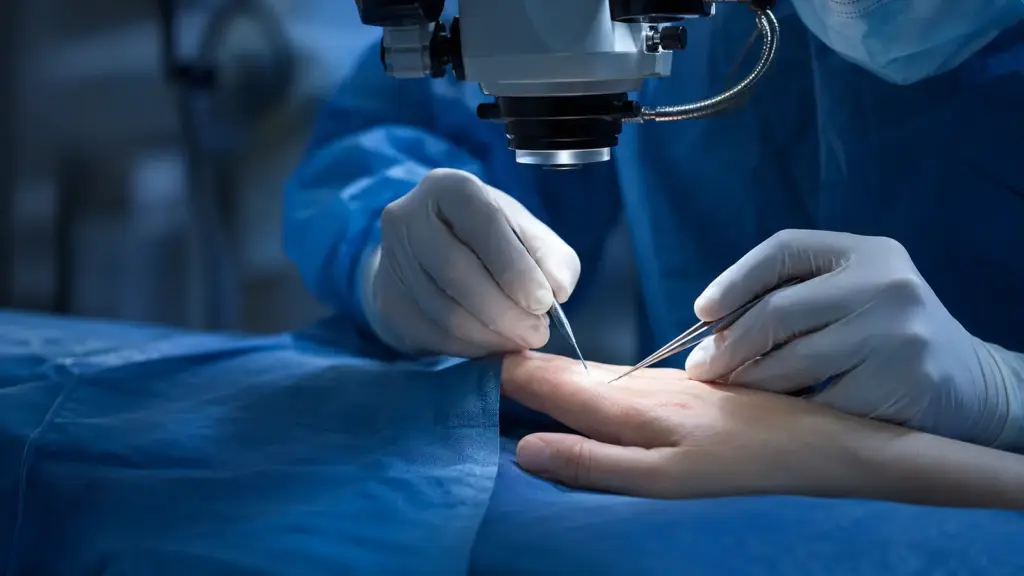
Microsurgery is an advanced surgical technique that uses an operating microscope and specialized fine surgical instruments to repair blood vessels and nerves at the millimeter level. In hand surgery, it is used particularly for injuries caused by cutting tools, replantation of severed fingers, and complex nerve repairs.
What Is the Microsurgery Method?
In microsurgery, the surgeon works under an operating microscope that provides 10- to 40x magnification. Blood vessels and nerves are joined end-to-end using special suture materials with a diameter of less than one millimeter. This technique is critical for restoring blood flow to the tissue and maintaining nerve conduction.
What Does Hand Surgery Involve?
The primary conditions evaluated and treated within the scope of hand surgery are as follows:
- Hand and wrist fractures
- Tendon ruptures and injuries
- Nerve compression conditions such as carpal tunnel syndrome
- Dupuytren’s contracture
- Osteoarthritis of the hand joints
- Congenital hand anomalies
According to Prof. Dr. Hasan Göçer, early and accurate assessment of hand injuries is just as critical for functional recovery as the surgical technique itself.
What Does Hand Surgery Cover?
Hand surgery covers a broad scope of conditions, including not only acute post-traumatic injuries but also chronic pain, recurrent entrapment syndromes, and congenital hand deformities. During the examination, hand function, grip strength, sensation, and joint range of motion are examined in detail.
The Microsurgery Procedure
The microsurgery procedure generally follows similar steps, although these may vary depending on the type of injury.
- The extent of the injury is assessed through imaging and clinical examination.
- General or regional anesthesia is administered.
- Damaged tissue is debrided, and any bone is identified.
- Vascular and nerve repair is performed under a surgical microscope.
- The wound is closed after verifying blood flow and nerve function.
What Is Microsurgery and Who Is It Performed On?
Microsurgery is performed for the reattachment (replantation) of severed fingers or hand segments, severe nerve injuries, complex vascular injuries, and certain reconstructive procedures requiring tissue grafting. The success of the procedure is directly dependent on the time elapsed between the injury and surgery, as well as the viability of the tissue.
Clinical Assessment by Prof. Dr. Hasan Göçer
“In my clinical practice, I have observed that in hand injuries, getting the patient to an evaluation as quickly as possible from the scene of the incident directly affects the chances of success in nerve and vascular repair. Delay can negatively affect tissue viability and, consequently, the functional outcome.”
Prof. Dr. Hasan Göçer — Orthopedic and Traumatology Specialist
This observation illustrates why time is critical in hand injuries. Prof. Dr. Göçer emphasizes that, in his clinical practice, rapid referral following an injury is one of the most important factors increasing the success of microsurgical repair.
From Diagnosis to Recovery: How Does the Process Proceed?
| Stage | Time | What Happens? |
|---|---|---|
| Initial Evaluation | 0–6 Hours | The extent of the injury is determined, and the condition of theand nerve status are assessed |
| Surgical Planning | Same Day | The order of bone, tendon, nerve, and vascular repairs is planned |
| Surgery | Same Day/Next Day | Bone fixation, tendon repair, and microsurgical vascular and nerve repair are performed |
| Hospital Stay | Days 1–5 | Monitoring of blood flow, pain management, application of a cast or splint |
| Recovery | Weeks 4–12 | Restoration of function and sensation through supervised hand therapy |
The initial evaluation is performed quickly due to the urgent nature of the injury, and vascular and nerve integrity are checked as a priority. In surgical planning, bone fixation is generally performed first, while vascular and nerve repair is carried out during the microsurgical phase. Tissue perfusion is closely monitored during the hospital stay. A controlled movement program conducted under the supervision of a hand therapist during the recovery period is important for preventing tendon adhesions.
Frequently Asked Questions
Which hospitals offer hand surgery?
Hand surgery and microsurgery services are provided at hospitals and clinics staffed by orthopedic and trauma specialists with expertise in this field. We recommend contacting the facility directly for up-to-date information on where you can be evaluated.
What are hand surgery and microsurgery?
Hand surgery involves the treatment of bone, tendon, nerve, and joint problems in the hand and wrist. Microsurgery, on the other hand, is an advanced surgical technique used in these treatments, in which millimeter-sized blood vessels and nerves are repaired under a microscope.
What conditions does the hand surgery department treat?
Fractures, tendon injuries, carpal tunnel syndrome, Dupuytren’s contracture, osteoarthritis of the hand joints, and congenital hand anomalies are all treated within the scope of hand surgery.
In which surgeries is microsurgery used?
Microsurgical techniques are used in the reattachment of severed finger or hand segments, severe nerve injuries, complex vascular injuries, and certain reconstructive surgeries requiring tissue transfer.
Which department does microsurgery of the hand fall under?
Microsurgery of the hand is a specialized field of treatment within the specialty of orthopedics and traumatology, performed by physicians who have received advanced training in microsurgery.
Conclusion
Hand surgery and microsurgery are specialties that enable the repair of injuries to the hand’s complex anatomical structure using precise techniques. Timely intervention, particularly in emergency injuries, directly impacts the functional outcome. You can begin the consultation process to have your specific condition evaluated regarding hand surgery. Prof. Dr. Hasan Göçer evaluates each patient’s clinical presentation individually to determine the most appropriate treatment options.
Sources
- American Academy of Orthopaedic Surgeons (AAOS) — OrthoInfo, “Hand Fractures” — https://orthoinfo.aaos.org/en/diseases–conditions/hand-fractures/
- National Institutes of Health (NIH) — StatPearls, “Microsurgery” — https://www.ncbi.nlm.nih.gov/books/NBK563244/
- Hospital for Special Surgery (HSS) — “Hand and Wrist Conditions Overview” — https://www.hss.edu/condition-list_hand-wrist.asp