🦴 Quick Facts from Prof. Dr. Göçer
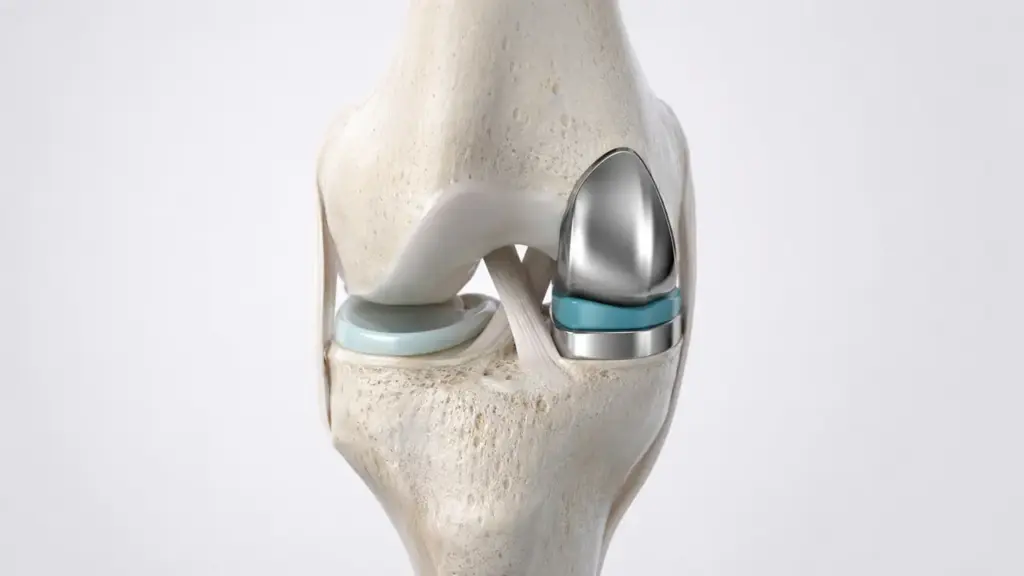
- Unicondylar knee replacement is a single-compartment knee replacement in which only one compartment (condyle) of the knee joint is replaced with an artificial component.
- It is performed when osteoarthritis affects only one compartment of the knee (most commonly the medial compartment) and the anterior cruciate ligament is intact.
- Involvement of the medial compartment is approximately 10 times more common than that of the lateral compartment.
- Since healthy compartments and ligaments are preserved, the procedure can be converted to a total knee replacement in the future if necessary.
Knee osteoarthritis does not always affect the entire joint; sometimes, wear and tear is limited to a single compartment of the knee. Unicondylar knee replacement is a surgical procedure used in these cases, in which only the damaged compartment (condyle) is covered with artificial components, while healthy tissues are preserved. It is also known as a partial (half) knee replacement.
What Is a Unicondylar Knee Replacement?
A unicondylar knee replacement is a type of knee replacement in which only the worn-out compartment of the knee joint is covered with artificial components. “Uni” means “single,” and “condylar” refers to the compartment of the knee known as the condyle. The knee is divided into three compartments: the inner (medial), outer (lateral), and patellofemoral compartments; in a unicondylar prosthesis, only one of these is replaced.
Osteoarthritis most commonly affects the medial compartment; therefore, the vast majority of unicondylar prostheses are implanted in the medial compartment. Involvement of the lateral compartment is rarer and technically more challenging. In this respect, the unicondylar prosthesis differs from the total knee replacement, in which the entire knee is replaced.
Who Is a Candidate for a Unicondylar Knee Replacement?
Unicondylar knee replacement is not performed on every patient with osteoarthritis, but only on those who meet specific criteria. Proper patient selection is critical to the success of this procedure. General eligibility criteria include:
- Unicompartmental involvement: Osteoarthritis must be limited to only one compartment of the knee (most commonly the medial compartment).
- Intact anterior cruciate ligament (ACL): The anterior cruciate ligament (ACL), which provides anteroposterior stability to the knee, must remain functional.
- Adequate range of motion: The knee must be able to bend and straighten to a reasonable extent.
- Correctable alignment: There must be no forward or fixed misalignment along the leg axis.
According to Prof. Dr. Hasan Göçer, the most critical step in unicondylar knee replacement is confirming that osteoarthritis is truly limited to a single compartment and that the anterior cruciate ligament is intact; when these conditions are met, this method—which preserves healthy tissue—can offer both faster recovery and a more natural knee sensation.
How Is Unicondylar Knee Replacement Performed?
Unicondylar knee replacement surgery is performed under general or regional anesthesia using a smaller incision than that required for total knee replacement. Since the procedure targets only the damaged compartment, it requires less intervention in the surrounding tissues. The general steps are as follows:
- Anesthesia: The appropriate anesthesia method is administered to the patient.
- Access: The damaged segment is accessed through a small incision.
- Evaluation: The integrity of the other segments and ligaments is verified.
- Surface Preparation: Only the surfaces within the worn segment are carefully prepared.
- Prosthesis Placement: Components of the appropriate size are placed in the relevant segment, and the incision is closed.
During surgery, it is confirmed that the osteoarthritis is truly limited to a single compartment and that the other compartments are intact. Preserving healthy cartilage and cruciate ligaments ensures that the knee’s natural range of motion is largely maintained.
Clinical Assessment by Prof. Dr. Hasan Göçer
“In my clinical practice, I emphasize that the most valuable aspect of the unicondylar prosthesis is that it is based on the principle of ‘surgery only as needed.’ By leaving healthy compartments and ligaments intact and replacing only the damaged compartment, this approach provides both rapid recovery and a natural knee sensation in appropriately selected patients.”
Prof. Dr. Hasan Göçer — Orthopedic and Traumatology Specialist
Another advantage of this approach is its flexibility. If osteoarthritis develops in other compartments in the future, a unicompartmental knee replacement can be converted to a total knee replacement relatively easily. However, this flexibility is meaningful only with proper patient selection; in cases of incorrect selection, the outcome may not be as desired.
The Difference Between Unicondylar Knee Replacement and Total Knee Replacement
The fundamental difference between the two methods lies in the extent of the area being replaced. The table below summarizes the general differences; which method is appropriate is evaluated on a case-by-case basis for each patient.
| Feature | Unicondylar Knee Replacement | Total Knee Replacement |
|---|---|---|
| Scope | Single compartment | Entire joint |
| Incision | Smaller | Larger |
| Ligament Preservation | Cruciate ligaments are preserved | Some ligaments may be removed |
| Recovery | Generally faster | May take longer |
| Indications | Unicompartmental involvement | Widespread involvement |
While unicondylar knee replacement offers less tissue damage and faster healing in suitable patients, total knee replacement is necessary when osteoarthritis affects multiple compartments of the knee. The decision is made based on imaging and physical examination findings.
Recovery Process After Unicondylar Knee Replacement
Recovery after unicompartmental knee replacement is generally faster than after total knee replacement, thanks to the preserved tissues and the small incision. Many patients can get out of bed and begin walking with assistance early on.
- Early phase (first few days): Getting out of bed and walking with assistance begin under the supervision of a physical therapist.
- First weeks: Many patients can transition to independent walking during this period; exercises continue.
- First months: A gradual return to daily activities is achieved.
- Advanced stage: Knee strength and range of motion are largely regained.
The rate of recovery depends on the patient’s overall condition, muscle strength, and adherence to physical therapy. Thanks to the preserved cruciate ligaments, many patients feel that their knee is more “like their own” compared to a total knee replacement.
From Surgery to Recovery: How Does the Process Proceed?
| Stage | Time | What Happens? |
|---|---|---|
| Evaluation | Pre-surgery | Confirmation that the condition is limited to a single septum and that the ligaments are intact |
| Surgery | Day of the procedure | Only the damaged compartment is replaced with a prosthesis via a small incision |
| Early Recovery | First Few Days | Standing and walking begin with physical therapy |
| Physical Therapy | Weeks | Mobility and muscle strength are rapidly regained |
| Follow-up | Long-term | The condition of the prosthesis and other compartments is regularly monitored |
Evaluation and Surgery: It is confirmed that osteoarthritis is limited to a single compartment and that the ligaments are intact; if appropriate, a prosthesis is implanted via a small incision.
Recovery and Physical Therapy: Walking begins early on; mobility and strength are rapidly regained thanks to the preserved tissues.
Follow-up: The condition of the prosthesis and the other compartments of the knee is monitored through regular follow-up visits over the long term.
Frequently Asked Questions
Is a unicondylar prosthesis the same as a partial knee replacement?
Yes; a unicondylar prosthesis is the medical term for a partial (half) knee replacement. Both refer to a single-compartment prosthesis in which only the damaged part of the knee is replaced, while healthy tissues are preserved.
Who is not a candidate for a unicondylar knee replacement?
Unicondylar knee replacement is not suitable for patients in whom osteoarthritis affects more than one compartment of the knee, the anterior cruciate ligament is insufficient, or there is a severe, fixed deformity in the leg axis. In these cases, total knee replacement is generally preferred.
Can a unicondylar knee replacement be converted to a total knee replacement later?
Yes; if osteoarthritis develops in other compartments of the knee in the future, a unicondylar prosthesis can be converted to a total knee replacement relatively easily. This flexibility is one of the advantages of the procedure.
How long does a unicondylar prosthesis last?
Unicondylar prostheses can function effectively for many years in suitable patients. Their lifespan varies depending on the patient’s age, weight, and activity level. Regular checkups are important for monitoring the condition of both the prosthesis and the other parts of the knee.
Conclusion
Unicondylar knee replacement surgery is an effective method for relieving pain while preserving healthy tissue in suitable patients whose osteoarthritis is limited to a single compartment of the knee. Key advantages include a small incision, preservation of the cruciate ligaments, and generally faster recovery. Its success depends largely on proper patient selection; the appropriate method must be evaluated individually for each patient.
You can begin the consultation process to have your personal situation evaluated regarding unicompartmental knee replacement surgery. Prof. Dr. Hasan Göçer evaluates appropriate treatment options by addressing each patient’s clinical presentation individually.
References
- NCBI/PMC, “Lateral unicompartmental knee arthroplasty … a narrative review,” 2024 — https://pmc.ncbi.nlm.nih.gov/articles/PMC12705726/
- NCBI/PMC, “Lateral UKA showed a lower risk of failure compared to medial UKA (RIPO Register)”, 2023 — https://www.ncbi.nlm.nih.gov/pmc/articles/PMC10191902/
- ScienceDirect Topics, “Unicompartmental Knee Arthroplasty — an overview” — https://www.sciencedirect.com/topics/medicine-and-dentistry/unicompartmental-knee-arthroplasty