? Quick Tips from Prof. Dr. Göçer
- Hip revision arthroplasty is a surgical procedure in which a previously implanted hip prosthesis is partially or completely replaced due to loosening, infection, dislocation, or wear.
- According to international registry data, the 25-year survival rate for primary hip replacements is 58% on average; revision may become necessary over time for the remaining patients (Lancet, 2019).
- The most common causes of revision are infection, instability (dislocation), periprosthetic fractures, and aseptic loosening (AJRR / AAOS, 2023).
- Revision surgery is technically more complex than the initial hip replacement and requires detailed preoperative planning.
A hip prosthesis implanted years ago may loosen, wear down, or become infected over time; in such cases, the prosthesis must be replaced. Hip revision replacement is a procedure in which part or all of the existing prosthesis is removed and replaced with a new one; it requires more detailed planning than the initial hip replacement surgery.
What Is a Hip Revision Replacement?
Hip revision replacementis a surgical procedure in which one or more components of a previously implanted total hip replacement are removed and replaced with new ones. Since the components placed in healthy bone during the initial surgery often need to work with weakened or damaged bone during revision, the procedure is more complex.
What is hip replacement revision surgery?
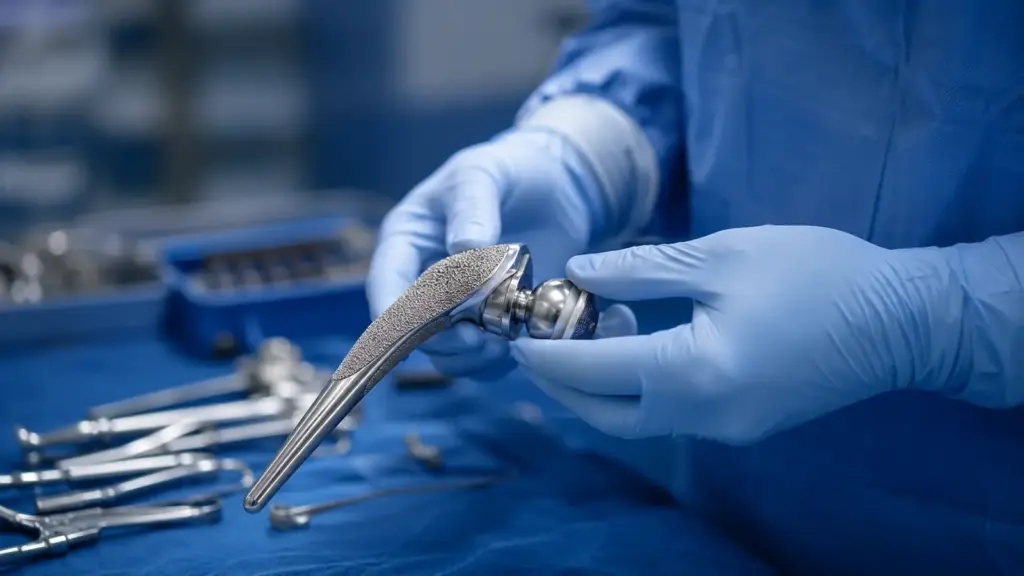
Hip replacement revision surgery aims to replace the problematic part of the existing prosthesis (the socket, head, stem, or all of them). Revision can range from the replacement of a single component to the complete reconstruction of the entire prosthesis and the supporting bone tissue.
The most common causes of revision are as follows:
- Aseptic loosening (separation of components from the bone over time)
- Peri-prosthesis infection
- Recurrent prosthesis dislocation (instability)
- Wear of joint surfaces
- Fracture of the bone surrounding the prosthesis
According to Prof. Dr. Hasan Göçer, the key to success in revision surgery is clearly identifying the cause of the prosthesis failure before the operation; in particular, ruling out a hidden infection is the most critical step in the revision plan.
Hip Replacement Revision Surgery
How is hip replacement revision surgery performed?
During revision surgery, the surgeon first carefully removes the problematic components; then evaluates the weakened bone tissue and uses a bone graft if necessary. In the final stage, new prosthetic components compatible with the bone support are implanted. Depending on the extent of bone loss, the procedure may take significantly longer than the initial surgery.
- Planning is carried out using detailed preoperative imaging and, if necessary, infection tests
- Problem components of the existing prosthesis are removed
- Bone loss is assessed; bone grafts and support components are used if necessary
- The new prosthesis components are secured in a stable foundation
- Joint stability is checked, and the tissue layers are closed
Risks of hip replacement revision surgery
The risks of hip prosthesis revision surgery are higher than those of the initial prosthesis surgery because the procedure takes longer and involves working with weakened bone. The main risks include infection, bleeding, prosthesis dislocation, nerve and blood vessel injury, and prolonged recovery. These risks are minimized through detailed preoperative preparation and an experienced surgical approach.
Prof. Dr. Göçer emphasizes that in his clinical practice, significantly more time must be allocated to preoperative planning for revision surgery than for the initial surgery; because when the type of components to be removed, the extent of bone loss, and the possibility of infection are known in advance, the surgery proceeds much more safely.
Clinical Assessment by Prof. Dr. Hasan Göçer
“In my clinical practice, I view revision surgery as a puzzle that requires much more planning than the initial prosthesis. Clarifying the answers to questions such as ‘why did it loosen,’ ‘is there a hidden infection behind it,’ and ‘how much bone loss has occurred’ before surgery directly determines the outcome. A properly identified problem can be resolved with a properly planned revision; whereas a rushed revision carries the risk of a second failure.”
Prof. Dr. Hasan Göçer — Orthopedic and Traumatology Specialist
The practical importance of this assessment is that revision surgery is not simply a “second standard procedure.” Preoperative steps, such as mapping bone loss and ruling out infection, directly affect the success of the revision and the long-term durability of the prosthesis.
From Diagnosis to Recovery: How Does the Process Proceed?
| Stage | Time | What Happens? |
|---|---|---|
| Initial Examination | Day 1 | Pain and functional assessment; an X-ray is requested to assess the condition of the existing prosthesis |
| Evaluation & Planning | Weeks 1–3 | Bone loss is mapped using X-rays/CT scans; infection tests are performed if necessary |
| Surgery | Scheduled day | Problem components are removed; a new prosthesis is implanted with a bone graft if necessary |
| Hospital Stay | Days 3–7 Days | Supervised weight-bearing, pain management, and monitoring for infection and circulation |
| Recovery | Weeks 8–16 | Gradual weight-bearing, physical therapy, and regular follow-up visits (may be longer than with the first prosthesis) |
Initial Examination: Pain related to the current prosthesis, history of dislocation, and functional loss are assessed. X-rays reveal signs of loosening or wear.
Evaluation and Planning: The extent of bone loss is mapped using imaging. Blood tests and joint fluid analysis may be performed if a hidden infection is suspected.
Surgery and Hospital Stay: When a bone graft is used, the weight-bearing protocol is tailored to the individual. The hospital stay may be slightly longer than for the initial prosthesis surgery.
Recovery: Recovery after revision surgery generally takes longer than after the initial prosthesis. Regular physical therapy and follow-up visits are important for monitoring the fit of the new prosthesis.
Frequently Asked Questions
What is a hip revision prosthesis?
Hip replacement revision is a surgical procedure in which part or all of a previously implanted hip prosthesis is replaced. The most common causes are loosening, infection, recurrent dislocation, and wear. The procedure is more complex than the initial hip replacement surgery and requires detailed planning.
What are the experiences of people who have undergone hip replacement revision surgery?
Experiences vary from person to person; recovery depends on the reason for the revision (loosening, infection, etc.), the degree of bone loss, and the patient’s overall condition. In general, recovery after revision may take slightly longer than after the initial hip replacement surgery. It is best to consult with the doctor who examined you to establish realistic expectations.
What is revision surgery?
Revision surgery refers to the replacement or correction of a previously performed surgical procedure (in this context, a hip replacement). In the case of a hip replacement, revision involves removing the problematic components of the existing prosthesis and replacing them with new ones.
How many types of hip replacements are there?
Hip replacements are primarily divided into two categories: total (where both the socket and the femoral head of the joint are replaced) and partial (where only the femoral head is replaced). There is also a distinction between a primary prosthesis—which is implanted for the first time—and a revision prosthesis, which replaces an existing prosthesis. The appropriate type of prosthesis is determined by the physician based on age, bone structure, and diagnosis.
Why does a hip replacement require revision?
Over time, a prosthesis may become loose, wear out, become infected, or dislocate repeatedly; in these cases, revision is necessary. According to international registry data, the 25-year survival rate for primary hip replacements is 58% on average, meaning that revision may become necessary for some patients many years later. If you experience pain, recurrent dislocation, or loss of function, you should consult your doctor.
Conclusion
In this article, we discussed what a hip revision replacement is, the reasons it may be necessary, how the surgery is performed, and its risks. Although revision surgery is more complex than the initial hip replacement surgery, it is a procedure that can be successfully managed with proper diagnosis of the problem and detailed planning.
You can begin the consultation process to evaluate your personal situation regarding hip revision replacement. Prof. Dr. Hasan Göçer evaluates each patient’s clinical case individually to determine the appropriate treatment options.
References
- Evans JT et al. How long does a hip replacement last? A systematic review and meta-analysis. The Lancet, 2019 — https://www.thelancet.com/journals/lancet/article/PIIS0140-6736(18)31859-2/fulltext
- Cieremans DA et al. Revision indications and implant survivorship in THA (AJRR data). AAOS Annual Meeting, 2023 — https://www.aaos.org/
- OrthoInfo (AAOS), Revision Total Hip Replacement — https://orthoinfo.aaos.org/en/treatment/revision-total-hip-replacement/