🦴 Quick Facts from Prof. Dr. Göçer
- Total knee replacement is a surgical procedure in which damaged joint surfaces are replaced with an artificial prosthesis in cases of advanced knee osteoarthritis.
- It is considered for patients in whom non-surgical treatments have proven insufficient and whose quality of life has been significantly affected.
- Approximately 95% of patients are satisfied with the results; the majority experience significant pain relief and improved mobility within the first year.
- The 15-year survival rate for modern knee replacements is approximately 90 percent.
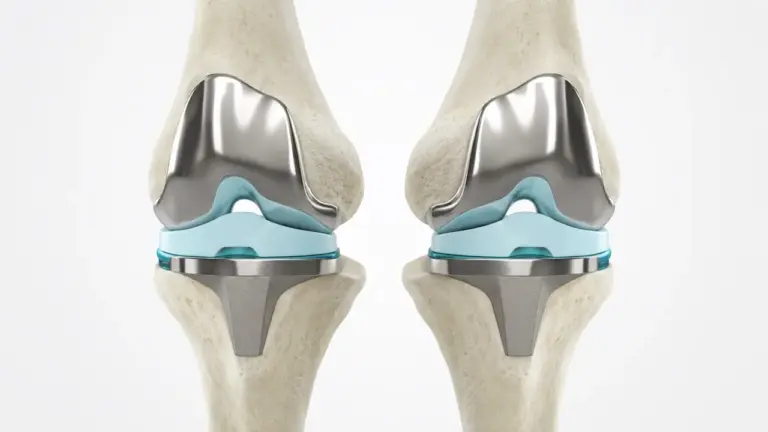
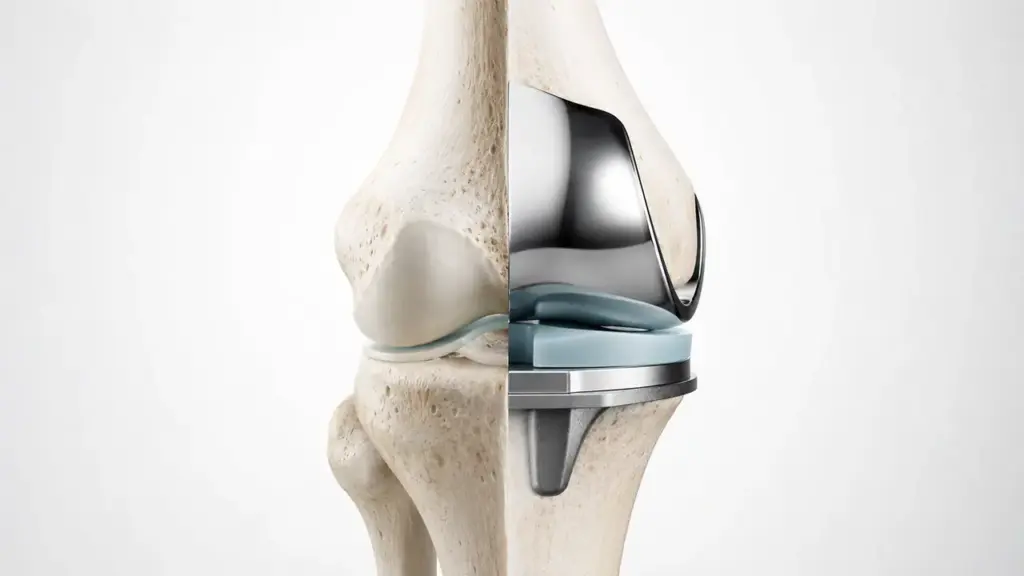
In advanced knee osteoarthritis, pain often reaches a level that makes it difficult to carry on with daily life. Total knee replacement, is a surgical procedure in which the worn and damaged surfaces of the knee joint are replaced with a prosthesis made of metal and special plastic components. The goal is to relieve pain, restore mobility, and improve quality of life.
What Is Total Knee Replacement?
Total knee replacement involves removing the worn-out portions of the surfaces of the femur, tibia, and, if necessary, the patella—the bones that make up the knee joint—and replacing them with artificial components. These components are designed to mimic the smooth, pain-free movement of a healthy joint.
The term “total” refers to the complete replacement of the joint surface by evaluating all three main components of the knee, rather than just a portion of it. In this regard, it differs from a partial (partial) prosthesis.
Who Is Eligible for a Total Knee Replacement?
Total knee replacement is not recommended for every patient with knee pain, but rather for those who meet specific criteria. Generally, it is considered in the following situations:
- Advanced osteoarthritis: Widespread cartilage wear affecting multiple compartments of the knee.
- Insufficiency of non-surgical treatments: Pain that persists despite physical therapy, weight management, medication, and injections.
- Significant decline in quality of life: Severe limitations in walking, using stairs, and performing daily activities.
- Rest and nighttime pain: Pain that does not subside with rest and disrupts sleep.
According to Prof. Dr. Hasan Göçer, the decision to perform total knee replacement should be based not only on the degree of wear visible on an X-ray but also on the patient’s limitations in daily life; because the primary goal is not to correct an appearance but to enable the person to move without pain.
How Is Total Knee Replacement Surgery Performed?
Total knee replacement surgery is performed under general or regional anesthesia. The procedure involves removing the damaged joint surfaces and replacing them with prosthetic components. The general steps are as follows:
- Anesthesia: The appropriate anesthesia method is administered to the patient.
- Access: The joint is accessed through an incision in the front of the knee.
- Removal of the Damaged Surface: Worn cartilage and bone surfaces are carefully removed.
- Prosthesis Placement: The femoral, tibial, and, if necessary, patellar components are implanted.
- Closure: After checking alignment and mobility, the incision is closed.
The surgery is typically completed within a few hours, although this may vary depending on the surgeon’s experience and the patient’s condition. The components are usually fixed with bone cement; cementless options may also be considered depending on the patient.
Clinical Assessment by Prof. Dr. Hasan Göçer
“In my clinical practice, I have observed that the success of total knee replacement is determined not only by the surgery itself but also by the patient’s participation in the subsequent physical therapy process. When performed with the correct indication and combined with regular exercise, a knee replacement can enable the patient to lead a pain-free and active life for many years.”
Prof. Dr. Hasan Göçer — Orthopedic and Traumatology Specialist
This approach is of great practical importance. Knee replacement surgery is not the end of the process; it is the beginning of a return to pain-free movement. Physical therapy initiated in the early postoperative period determines the longevity of the outcome by restoring both joint range of motion and muscle strength.
Total Knee Replacement Recovery Process
The total knee replacement recovery process follows a specific course, although it varies from patient to patient. Getting up and walking usually begins in the days following surgery; full recovery, however, occurs gradually over weeks and months.
- Early phase (first few days): Getting up and walking with support begins under the guidance of a physical therapist.
- First weeks: Exercises are performed to increase joint range of motion and strengthen muscles.
- First months: A gradual return to daily activities is achieved; walking distance increases.
- Later stage: Most patients enter a phase where pain is significantly reduced and movement becomes easier.
The rate of recovery depends on the patient’s overall health, preoperative muscle strength, and adherence to physical therapy. Regular exercise and adherence to the doctor’s recommendations are the most critical factors in the process.
What Is the Lifespan of a Total Knee Replacement?
Modern knee replacements are designed to be long-lasting. According to the literature, the 15-year survival rate for current prostheses is reported to be approximately 90%. This means that the vast majority of prostheses continue to function for 15 years or more.
The main factors affecting the lifespan of a prosthesis are the patient’s age, activity level, weight, and overall health. Since the prosthesis wears down more quickly in younger and more active patients, revision surgery may be necessary in the future. Regular checkups are important for monitoring the condition of the prosthesis.
From Surgery to Recovery: How Does the Process Proceed?
| Stage | Time | What Happens? |
|---|---|---|
| Evaluation | Pre-surgery | Suitability is determined via X-ray and examination; a plan is developed |
| Surgery | Day of the procedure | Damaged surfaces are replaced with a prosthesis under anesthesia |
| Early Recovery | First few days | Standing and walking begin with physical therapy |
| Physical Therapy | Weeks–months | Range of motion and muscle strength are gradually increased |
| Follow-up | Long-term | The condition of the prosthesis is monitored through regular checkups |
Evaluation and Surgery: Suitability is determined by X-rays and examination; during surgery, the damaged joint surfaces are replaced with a prosthesis.
Recovery and Physical Therapy: Walking begins in the early stages; mobility and strength are regained through physical therapy in the following weeks.
Follow-up: The function and condition of the prosthesis are monitored through regular follow-up visits over the long term.
Frequently Asked Questions
How long does a total knee replacement last?
The vast majority of modern knee replacements remain functional for many years; the literature reports a 15-year survival rate of approximately 90%. The lifespan of the prosthesis may vary depending on the patient’s age, weight, and activity level.
When can you walk after total knee replacement?
Walking with assistance typically begins in the days following surgery, under the supervision of a physical therapist. The transition to independent walking occurs gradually over the course of several weeks. The process varies depending on the patient’s condition and compliance with physical therapy.
Is total knee replacement surgery risky?
Total knee replacement is a widely performed surgical procedure with a high success rate; approximately 95% of patients are satisfied with the results. Although, like any surgery, it carries risks such as infection or blood clots, these risks are kept low with appropriate patient selection and proper care.
Can the knee bend after total knee replacement?
Yes; one of the goals of the surgery is to restore the knee’s ability to bend and straighten. Range of motion gradually increases with physical therapy. Most patients regain a range of motion sufficient for daily activities.
When does the pain from total knee replacement go away?
Pain related to the surgery gradually decreases during the first few weeks. A significant reduction in the previous pain caused by osteoarthritis is typically felt by most patients within the first few months. The recovery process varies from person to person.
Conclusion
Total knee replacement is a highly successful surgical procedure performed to relieve pain and restore mobility in advanced-stage knee osteoarthritis. The decision to undergo surgery should be based not only on imaging results, but also on the patient’s limitations in daily life. Adherence to physical therapy after surgery is the most important factor determining both the speed of recovery and the long-term success of the procedure.
You can begin the consultation process to have your personal situation evaluated regarding total knee replacement. Prof. Dr. Hasan Göçer evaluates appropriate treatment options by addressing each patient’s clinical presentation on an individual basis.
Sources
- World Health Organization / Medical Daily compilation, “Knee Replacement Surgery: Recovery & Success Rates,” 2026 — https://www.medicaldaily.com/…
- NCBI/PMC, “Cemented fixed-bearing PFC total knee arthroplasty: survival and failure analysis at 12–17 years” (15 years ~90% survival rate) — https://www.ncbi.nlm.nih.gov/pmc/articles/PMC3163768/
- NCBI/PMC, “Patient-reported outcomes and implant survivorship after total knee arthroplasty” — https://www.ncbi.nlm.nih.gov/pmc/articles/PMC6399845/