🦴 Quick Facts from Prof. Dr. Göçer
- Knee osteoarthritis is a degenerative joint disease caused by the gradual wear and tear of the cartilage in the knee joint.
- Knee osteoarthritis, which causes symptoms, is seen in approximately 10–15% of individuals aged 60 and older.
- According to the Kellgren-Lawrence classification, the disease is divided into 4 stages; stages 1–3 are typically managed with non-surgical methods.
- In advanced (stage 4) cases, surgery—particularly total knee replacement—is usually considered.
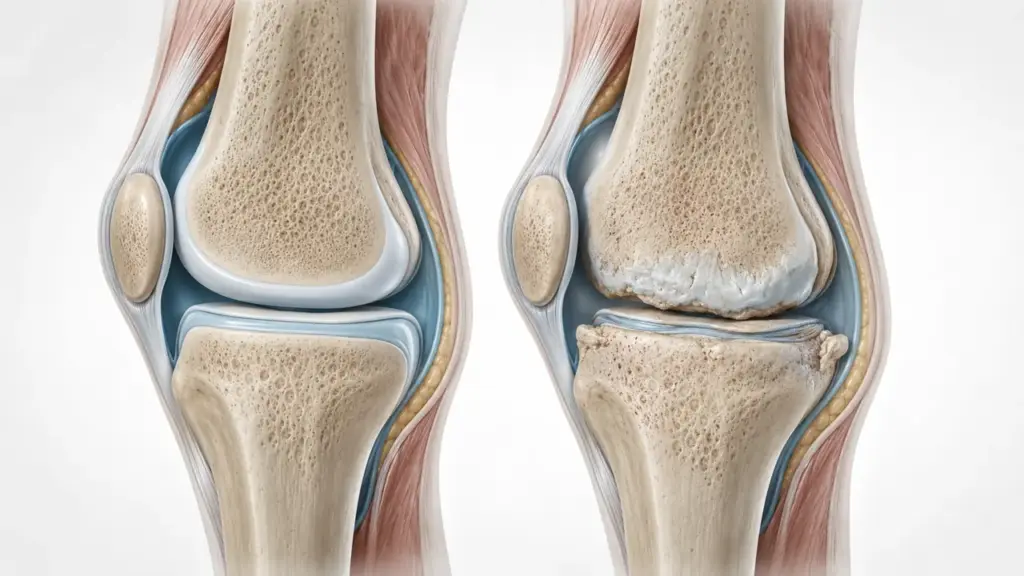
Stiffness and pain in the knee are often the first signs of cartilage wear. Knee osteoarthritis, medically known as gonarthrosis, is a progressive joint disease. As the cartilage wears away, the bone surfaces rub against each other, leading to pain and limited mobility.
What Is Knee Osteoarthritis (Gonarthrosis)?
Knee osteoarthritis is the degenerative (wear-and-tear-related) wear and tear of the cartilage in the knee joint. In a healthy knee, the cartilage covers the ends of the bones, providing smooth and cushioned movement. As this cartilage thins, the joint space narrows, the bones begin to rub against each other, and pain develops.
“Osteoarthritis” is a term commonly used by the general public; its medical term is osteoarthritis. Although all joints in the body can be affected, the knee is one of the most commonly affected areas because it is a weight-bearing joint.
What Causes Knee Osteoarthritis (Gonarthrosis)?
Knee osteoarthritis is not caused by a single factor; it develops due to a combination of multiple factors. The most important risk factors are as follows:
- Age: As we age, the cartilage’s ability to regenerate decreases.
- Excess weight: Body weight increases the load on the knee, accelerating wear and tear.
- Leg alignment issues: Alignment issues such as “O” or “X” legs cause an uneven distribution of load.
- Previous injuries: Meniscus or ligament injuries set the stage for cartilage wear.
- Heavy physical labor and strain: Subjecting the knee to constant high loads increases the risk.
- Genetic predisposition: A family history of osteoarthritis may increase the risk.
According to Prof. Dr. Hasan Göçer, cartilage wear may manifest at an earlier age, particularly when obesity and leg alignment abnormalities occur together; managing these two factors plays a significant role in slowing the progression of the disease.
Symptoms of Knee Osteoarthritis (Gonarthrosis)
Symptoms vary depending on the stage of the disease and generally progress insidiously, worsening over time. The most common symptoms of knee osteoarthritis are as follows:
- Pain that worsens with movement: This is particularly noticeable when starting to walk or going up and down stairs.
- Morning stiffness: A brief sensation of stiffness in the knee in the morning or after prolonged inactivity.
- Swelling: Occasional fluid buildup and swelling may be observed in the joint.
- Clicks and a sensation of catching: Cracking, grinding, or a sensation of the knee catching during movement.
- Limited range of motion: Difficulty fully bending or straightening the knee.
In advanced stages, pain may persist even at rest and at night, and a deformity in the leg’s alignment may become more pronounced. The severity of symptoms does not always correspond exactly to the changes seen on X-rays; in some people, significant wear and tear may cause few symptoms, while in others, even minor changes may be more bothersome.
How Is Knee Osteoarthritis Diagnosed and Staged?
The diagnosis is made through a physical examination and X-rays. X-rays are used to assess narrowing of the joint space, bone spurs (osteophytes), and bone sclerosis. In appropriate cases, an MRI provides additional information about cartilage and soft tissues. The disease is staged according to the Kellgren-Lawrence classification:
| Stage | X-ray Findings | General Approach |
|---|---|---|
| Stage 1 (suspicious) | Very mild changes, possible small osteophytes | Lifestyle modifications, follow-up |
| Stage 2 (mild) | Pronounced osteophytes, mild narrowing of the space | Physical therapy, weight control, medication |
| Stage 3 (moderate) | Noticeable narrowing, multiple osteophytes | Non-surgical treatment + injection options |
| Stage 4 (severe) | Significant narrowing, bone deformity | Usually surgical (prosthesis, etc.) |
This classification serves as an important framework for guiding treatment selection. Generally, patients in stages 1–3 are managed with non-surgical methods, while surgery is the primary option for stage 4 cases.
Clinical Assessment by Prof. Dr. Hasan Göçer
“In my clinical practice, I have observed that the majority of patients with early- and mid-stage knee osteoarthritis can remain comfortable for many years without surgery, through an appropriate exercise program and weight management. Surgery should be considered only when non-surgical options have been exhausted and quality of life is significantly impaired.”
Prof. Dr. Hasan Göçer — Specialist in Orthopedics and Traumatology
The practical importance of this approach is to avoid unnecessary or premature surgery. Strengthening the muscles around the knee can help balance the load on the joint, thereby reducing pain and delaying the need for a knee replacement for years. The treatment plan is personalized by evaluating the patient’s stage of the disease, age, and activity level together.
Knee Osteoarthritis Treatment
Treatment is planned in stages based on the stage of the disease and the severity of symptoms. The first step always involves non-surgical methods; when these prove insufficient, surgical options are considered.
Non-Surgical (Conservative) Treatment
Non-surgical treatment for knee osteoarthritis is the primary approach in mild and moderate stages. Physical therapy and exercises to strengthen the muscles around the knee, weight management, activity modification, and anti-inflammatory pain relievers are included in this group. These methods aim to reduce pain and preserve mobility.
Injection Therapies
In cases where pain cannot be adequately controlled with medication and exercise, intra-articular injections (such as hyaluronic acid, corticosteroids, or PRP) may be considered. These procedures can provide short- to medium-term relief in some patients; suitability is determined by a physician’s evaluation.
Surgical Treatment
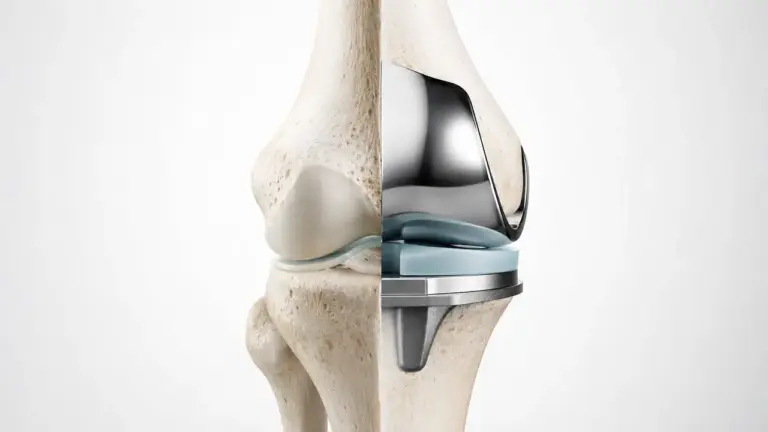
Surgery is considered when non-surgical methods prove insufficient and quality of life is significantly affected. Options include osteotomy to correct axial misalignment, partial knee replacement, which replaces a portion of the knee, and total knee replacement, which replaces the entire joint.
Prof. Dr. Göçer emphasizes that in clinical practice, the surgical method should be selected based on the patient’s age, activity level, and the extent of wear. For example, while osteotomy may be appropriate for a young patient with axial misalignment, a total knee replacement may be more suitable for an older patient with widespread wear.
Knee Osteoarthritis Surgery
Knee osteoarthritis surgery is performed in advanced-stage cases to relieve pain and restore mobility. The most commonly preferred method is total knee replacement surgery, in which the damaged joint surfaces are replaced with a prosthesis. In selected patients where wear is limited to only a portion of the knee, a partial (half) knee replacement may be performed.
Postoperative recovery varies from person to person depending on the type of surgery performed, the patient’s overall health, and adherence to physical therapy. Physical therapy started early on and regular exercise are an important part of surgical success.
From Diagnosis to Recovery: How Does the Process Proceed?
| Stage | Time | What Happens? |
|---|---|---|
| Initial Examination | Day 1 | The duration and nature of the pain are assessed; an X-ray is ordered |
| Evaluation & Staging | Week 1 | The stage of the disease is determined via X-ray (or MRI, if necessary) |
| Non-Surgical Treatment | Weeks–months | Physical therapy, weight management, medication, and injections (if necessary) are administered |
| Decision on Surgery | Depending on the response | If non-surgical treatment is insufficient, surgical options are evaluated |
| Recovery & Follow-up | Varies | The process is monitored through physical therapy and regular checkups |
Initial Examination and Staging: The duration of symptoms and their impact on daily life are assessed; the stage of the disease is determined via X-ray.
Non-Surgical Treatment: In the early and intermediate stages, physical therapy, weight management, and medication are prioritized. The goal is to reduce pain and preserve mobility.
Surgery and Recovery: If non-surgical methods prove insufficient, surgery is considered. Postoperative physical therapy and regular follow-up visits are an integral part of the recovery process.
Frequently Asked Questions
How is knee osteoarthritis treated?
Osteoarthritis is not a condition that “goes away” completely, but it is a condition that can be managed. In the early stages, symptoms can be significantly reduced through physical therapy, weight management, exercise, and pain relievers. In advanced stages, surgical options may be effective in relieving pain.
What helps relieve knee osteoarthritis pain?
Exercises that strengthen the muscles around the knee, weight loss, appropriate footwear, and adjusting activity levels are effective in reducing pain. Anti-inflammatory pain relievers and, when necessary, intra-articular injections can also be used as recommended by a doctor. Herbal remedies should not delay diagnosis or treatment.
How is knee replacement surgery performed?
The most commonly used method is total knee replacement; the damaged joint surfaces are replaced with a prosthesis made of metal and special plastic components. In patients with limited wear, partial replacement or corrective osteotomy may be preferred. The method is determined on a case-by-case basis.
How is knee osteoarthritis treated?
Treatment depends on the stage of the disease. In mild and moderate stages, non-surgical methods (exercise, weight control, medication) help manage symptoms in most patients. When wear and tear is very advanced, surgery may be the most effective option for lasting relief.
How can you tell if you have osteoarthritis?
Knee pain that worsens with movement, morning stiffness, swelling, and a clicking or grating sensation during movement are typical symptoms. A definitive diagnosis is made through a physical examination and X-rays; X-rays reveal narrowing of the joint space and bone spurs.
Does walking help with knee osteoarthritis?
Regular and balanced walking is beneficial for most patients by strengthening the muscles around the knee. However, it is important to avoid excessive and strenuous activities that increase pain. An appropriate walking program should be tailored to the patient’s stage of the condition based on the recommendation of a doctor or physical therapist.
Is knee osteoarthritis dangerous?
Knee osteoarthritis is not a life-threatening condition, but if left untreated, the pain and limited mobility can progress and reduce quality of life. Taking preventive measures early on helps slow the progression of the disease.
Conclusion
Knee osteoarthritis is a progressive joint disease that develops as a result of the gradual wear and tear of cartilage and is managed according to its stage. In the early and moderate stages, symptoms can be largely controlled through physical therapy, weight management, and appropriate exercise; while in the advanced stage, surgery is an effective option for relieving pain. Proper timing and a personalized plan help both avoid unnecessary surgery and maintain quality of life.
You can begin the examination process to assess your personal situation regarding knee osteoarthritis. Prof. Dr. Hasan Göçer evaluates each patient’s clinical presentation individually to determine the most appropriate treatment options.
Sources
- NCBI/PMC, “Therapeutic approaches in the management of knee osteoarthritis (Review)”, 2022 — https://pmc.ncbi.nlm.nih.gov/articles/PMC8972824/
- NCBI/PMC, “Conservative Trio-Therapy for Varus Knee Osteoarthritis” (Kellgren-Lawrence staging), 2022 — https://www.ncbi.nlm.nih.gov/pmc/articles/PMC9028347/
- NCBI/PMC, “Knee Osteoarthritis: Current Insights Into Pathophysiology and Non-surgical Management Options” — https://www.ncbi.nlm.nih.gov/pmc/articles/PMC12640556/