👨⚕️ Prof. Dr. Hasan Göçer📅 21 Temmuz 2026🕑 9 dk okuma
🦴 Quick Facts from Prof. Dr. Göçer
Bone metastasis occurs when cancer from another organ spreads to the bone and indicates that the underlying cancer is advanced (Stage 4).
Bone metastases can be observed in up to 70% of patients with advanced-stage breast cancer.
The most common symptom is bone pain; the primary treatment goals are pain control, fracture prevention, and maintaining mobility.
Palliative radiation therapy is one of the most effective methods for treating painful bone metastases.
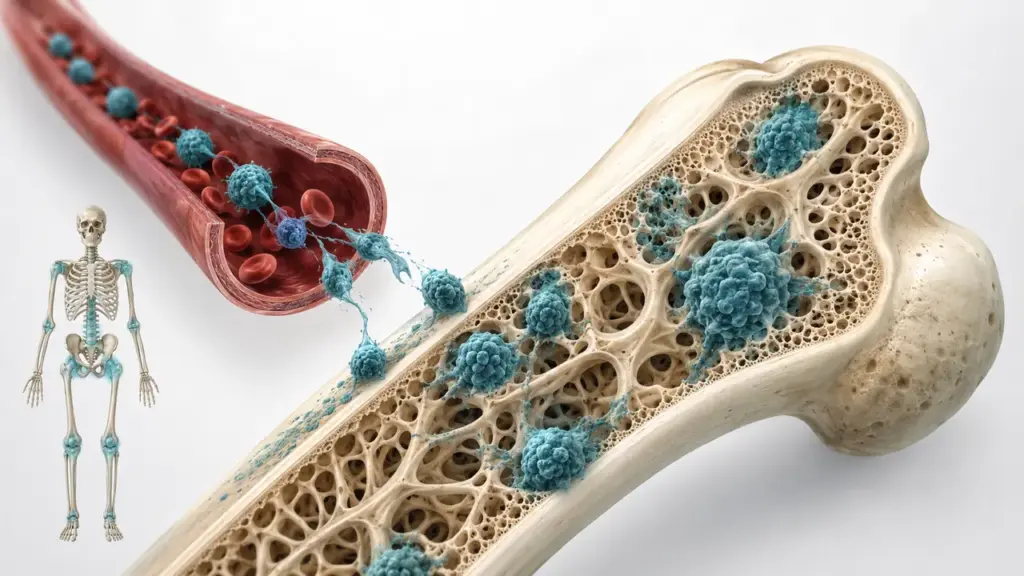
New-onset bone pain during cancer treatment may sometimes be a sign that the disease has spread to the bone. Bone metastasis is the spread of cancer, which originated in another organ of the body, to the bones via the bloodstream. In this case, treatment aims to both control the cancer and prevent bone-related problems such as pain and fractures.
What Is Bone Metastasis?
Bone metastasis occurs when cancer cells that originated in an organ (such as the breast, prostate, or lung) travel through the bloodstream to the bone and form new lesions there. Bone is one of the most common sites for cancer to spread to. Metastasis is not a primary bone cancer originating in the bone; it carries the cancer type of the source organ.
The spreading cells disrupt the bone’s normal balance of bone formation and resorption. Some metastases weaken the bone by dissolving it (lytic), while others lead to excessive bone formation (blastic). Both conditions can cause pain and increase the risk of fractures.
Symptoms of Bone Metastases
Symptoms vary depending on the affected bone and the extent of the metastasis. While some metastases are detected on imaging without causing symptoms, others lead to noticeable complaints. The main symptoms of bone metastases are as follows:
Bone pain: This is the most common symptom; it is usually constant and may become more pronounced at night.
Pathological fracture: Weakened bone may fracture with minimal stress or even spontaneously.
Signs of nerve compression: Weakness, numbness, and mobility issues may occur with spinal involvement.
High blood calcium: A condition that can cause fatigue, nausea, and excessive thirst.
General symptoms: Fatigue and unintentional weight loss may accompany the condition.
According to Prof. Dr. Hasan Göçer, new-onset and progressively worsening bone pain in patients with a history of cancer is the most commonly overlooked yet most important warning sign; early evaluation of this pain allows for the prevention of serious complications such as fractures.
Stages of Bone Metastasis
The presence of bone metastases indicates that the underlying cancer is generally advanced (Stage 4) because the cancer has spread beyond the organ where it originated to a distant site. Therefore, the “stage” is determined based on the primary cancer. Bone involvement, on the other hand, is categorized according to its extent, which helps shape treatment priorities.
Type of Involvement
What Does It Mean?
General Course
Single-focus (solitary)
A single metastatic site in the bone
Generally has a more favorable course
Limited (oligometastatic)
2–5 metastatic foci
May be suitable for targeted therapies
Widespread (multifocal)
Involvement of multiple bones
Systemic treatment is the primary approach
In conjunction with involvement of other organs
Such as bone + lung/liver
Course varies depending on the primary cancer
This distinction directly influences the treatment plan. For example, while radiation therapy or surgery may be the primary options for a single-site metastasis, systemic treatments are preferred for widespread involvement. A study on breast cancer reported that the prognosis for patients with single-site bone involvement was more favorable compared to those with spread to multiple organs.
How Is Bone Metastasis Diagnosed?
Bone metastases are detected through the combined use of multiple imaging methods. The goal is to determine the location of the involvement, its extent, and the risk of fracture.
X-ray: It can show areas of bone resorption or densification.
Bone scan: It scans the entire skeleton to reveal multiple sites of involvement.
MRI and CT: Show the details of the lesion and its relationship to adjacent structures.
PET-CT: Assesses the extent of the disease and active tumor regions.
Blood tests: Calcium levels and certain markers help assess the overall condition.
Imaging results help guide both the treatment plan and the prioritization of areas at risk for fracture. If metastasis-like lesions are detected in a patient without a known cancer, additional investigations are performed to identify the primary cancer.
Clinical Assessment by Prof. Dr. Hasan Göçer
“In my clinical practice, I emphasize that the goal of the orthopedic approach to bone metastases is not to ‘eradicate’ the disease, but to relieve the patient’s pain, prevent fractures, and ensure the patient can remain mobile. Taking preventive measures before a fracture develops in a weight-bearing bone directly protects the patient’s daily life.”
Prof. Dr. Hasan Göçer — Orthopedic and Traumatology Specialist
The importance of this approach stems from the multifaceted and supportive nature of bone metastasis treatment. When orthopedic intervention is planned in conjunction with oncological treatments that control cancer, it significantly contributes to the patient’s quality of life in terms of both pain management and the preservation of mobility.
How Are Bone Metastases Treated?
Treatment is tailored to the individual based on the type of primary cancer, the extent of the metastasis, and the risk of fracture. The goal is often to keep the cancer under control, reduce pain, and prevent bone-related complications. The decision is made through a joint evaluation by orthopedic and oncology teams.
Radiation Therapy
It is one of the most effective methods for treating painful bone metastases. It provides significant relief from pain and can slow the progression of the tumor. Targeted (stereotactic) radiation therapy allows for the delivery of high doses while sparing surrounding tissues.
Systemic Treatments
Depending on the type of primary cancer, chemotherapy, hormone therapy, or targeted therapies are administered. Additionally, medications that slow bone resorption (such as bisphosphonates and denosumab) help reduce pain and the risk of fractures.
Surgery (Orthopedic Intervention)
Bones at high risk of fracture may be stabilized as a preventive measure; if a fracture has occurred, repair or reconstruction with a prosthesis is performed. In cases of spinal involvement, procedures to relieve nerve compression may be performed.
Prof. Dr. Göçer emphasizes that, in clinical practice, orthopedic interventions must be timed in accordance with the patient’s overall condition and oncological treatment plan. A properly timed preventive intervention helps prevent fractures and the resulting loss of mobility.
What Helps with Bone Metastases?
The most effective way to alleviate the symptoms of bone metastases is to adhere strictly to the medical treatment plan. Medication, radiation therapy, and bone-strengthening drugs can be used together to manage pain. Additionally:
Regular medication use as prescribed by a doctor is important for pain management.
Avoiding heavy and strenuous physical activity is recommended to reduce the risk of fractures.
Physical therapy can help maintain mobility within safe limits.
A balanced diet and support for overall health contribute to the treatment process.
Herbal remedies or unproven treatments are not a substitute for medical treatment and may delay the healing process. The best approach is to plan all steps together with the treatment team.
From Diagnosis to Treatment: How Does the Process Proceed?
Stage
Time
What Happens?
Initial Evaluation
Day 1
Symptoms and cancer history are reviewed, physical examination and X-rays are performed
Imaging
Weeks 1–2
The extent of involvement is determined using scintigraphy, MRI/CT, and PET
Team Planning
Weeks 1–2
Orthopedics and oncology collaborate to develop a treatment plan
Treatment
Depending on the situation
Radiation therapy, systemic therapy, and surgery are performed as needed
Follow-up
Long-term
Pain, risk of fracture, and treatment response are monitored regularly
Initial Evaluation and Imaging: The patient’s cancer history and symptoms are assessed; the extent of involvement is determined using scintigraphy and MRI/CT.
Team Planning: The orthopedic and oncology teams work together to develop a plan that will both control the cancer and prevent bone complications.
Treatment and Follow-Up: Radiation therapy, systemic therapy, and, when necessary, surgery are employed. Pain and the risk of fractures are monitored regularly throughout the process.
Frequently Asked Questions
What helps with bone metastases?
The most effective approach is to adhere strictly to medical treatment. For pain management, medication, radiation therapy, and bone-strengthening drugs can be used together. Avoiding strenuous physical activity and undergoing physical therapy as recommended by a doctor can also be helpful. Herbal remedies are not a substitute for medical treatment.
Do bone metastases cause pain?
Yes, pain is the most common symptom. It is usually constant and may become more pronounced at night. Pain can be significantly reduced in most patients with radiation therapy and appropriate medication; therefore, it is important not to ignore the pain.
How are bone metastases treated?
Treatment is planned based on the type of primary cancer and the extent of the metastasis. Radiation therapy, systemic therapies (chemotherapy, hormone therapy, bone-strengthening medications), and surgery—when necessary—are used in combination. The goal is to reduce pain, prevent fractures, and preserve mobility.
What is the life expectancy for bone metastases?
Life expectancy varies significantly from person to person depending on the type of primary cancer, the extent of the disease, and the response to treatment. While the prognosis is generally more favorable in breast and prostate cancer, it may be shorter in some other cancers. A single-site metastasis is associated with a better prognosis compared to widespread disease. Therefore, it is not accurate to give a single timeframe; each patient is evaluated individually.
Do bone metastases cause death?
Bone metastases are a sign of advanced-stage cancer, and in most cases, a complete cure is not possible. However, this does not mean the condition is untreatable. With current treatments, the disease can be kept under control for a long time, pain can be reduced, and quality of life can be maintained.
Conclusion
Bone metastasis occurs when cancer from another organ spreads to the bone and is usually a sign of advanced-stage disease. Although a complete cure is often difficult to achieve, current treatments make it possible to control pain, prevent fractures, and maintain mobility. Early evaluation of bone pain—the most common symptom—and the multidisciplinary planning of treatment play a decisive role in preserving quality of life.
You can begin the examination process to assess your personal situation regarding bone metastases. Prof. Dr. Hasan Göçer evaluates each patient’s clinical presentation individually to determine the most appropriate treatment options.
Ortopedi ve Travmatoloji Uzmanı. Kemik ve yumuşak doku tümörleri cerrahisi, diz ve kalça protez cerrahisi ile revizyon protez cerrahisi başta olmak üzere ortopedik travmatoloji ve artroskopi alanlarında hasta odaklı yaklaşımıyla hizmet vermektedir.