? Quick Facts from Prof. Dr. Göçer
- Today, limb-sparing surgery has become the standard approach preferred over amputation in 85–90% of cases of bone and soft tissue tumors with appropriate indications. (Journal of Bone and Joint Surgery, 2022)
- In malignant bone tumors such as osteosarcoma and Ewing sarcoma, limb-sparing surgery following neoadjuvant chemotherapy does not adversely affect 5-year survival rates compared to amputation. (According to NCI/NIH data)
- The success of limb-sparing surgery depends largely on the tumor’s location, size, and the clarity of surgical margins; a negative surgical margin (R0 resection) is the primary goal.
- While the number of specialized centers in the field of orthopedic oncology is increasing in Turkey, evaluation by a multidisciplinary tumor board directly determines the quality of care.
“Will I lose my arm or leg?” — This question is perhaps the heaviest burden weighing on the minds of patients diagnosed with bone tumors or soft tissue tumors. Compared to decades ago, orthopedic oncology is in a very different place today: it is now possible to preserve the limb in the vast majority of cases. But “possible” does not mean “always.” Limb-sparing surgery is a process shaped by careful clinical decisions that requires proper patient selection and a multidisciplinary approach.
What Is Limb-Sparing Surgery?
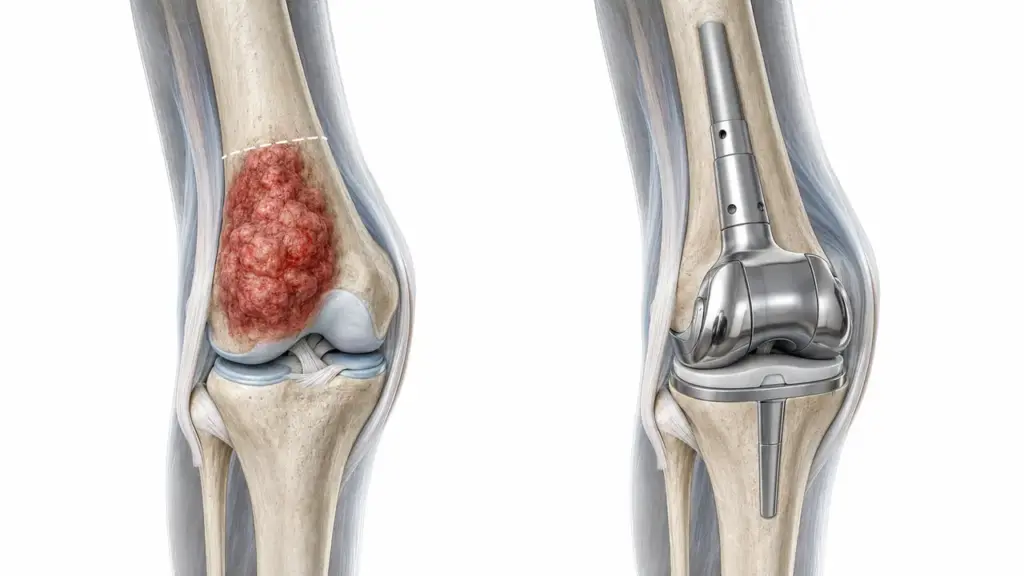
Limb-salvage surgery encompasses all surgical approaches that allow for the removal of malignant or aggressive benign bone and soft tissue tumors in the arm or leg, without amputating the limb. After the bone or soft tissue segment containing the tumor is resected, the resulting defect is reconstructed using a metal endoprosthesis, bone graft, allograft, or a combination thereof. The fundamental principle is to ensure that the patient retains a functional limb.
Bone and Soft Tissue Tumors: A Brief Overview
Bone tumors are classified into two categories: benign and malignant. Although malignant primary bone tumors are rare, they present with a serious clinical picture. According to data from the National Cancer Institute (NCI), osteosarcoma is the most common primary malignant bone tumor, with approximately 3–4 new cases per million people per year; Ewing sarcoma ranks second. Soft tissue sarcomas, on the other hand, originate in muscle, fat, blood vessels, and connective tissue; they account for approximately 3–5 cases per 100,000 adults per year.
Metastatic bone disease, however, is much more common than primary bone tumors: bone metastases from breast, lung, and prostate cancers account for the majority of this group. Limb-sparing surgery may also be considered for metastatic bone lesions that pose a risk of pathological fracture or cause severe pain.
Who Is a Candidate for Limb-Sparing Surgery?
According to Prof. Dr. Hasan Göçer, patient selection is the most critical factor determining the outcome in limb-sparing surgery: “Even if it is technically possible to save the limb, we must prioritize oncological safety. The clear margins of the surgical resection must never compromise the functional outcome.” Within this framework, the general eligibility criteria for limb-sparing surgery are as follows:
- The tumor must not have invaded major neurovascular structures (large blood vessels and nerves), or it must be possible to safely preserve these structures.
- There must be adequate soft tissue coverage and the possibility of reconstruction following resection.
- Achieving a negative surgical margin (R0) must be oncologically safe; a positive margin is unacceptable.
- The response to chemotherapy or radiation therapy in malignant tumors should be evaluated, and treatment-resistant cases should be addressed separately.
- The patient’s overall performance status and expected quality of life must justify the surgical risk.
The tumor’s location is also a determining factor: tumors around the knee (distal femur, proximal tibia) are more frequently technically suitable for limb-sparing surgery, while some pelvic or spinal tumors may require different approaches.
From Diagnosis to Recovery: The Limb-Sparing Surgery Process
| Stage | Time | What Happens? |
|---|---|---|
| 1. Diagnosis and Staging | 1–3 weeks | MRI, PET-CT, biopsy; tumor stage and surgical eligibility are determined |
| 2. Neoadjuvant Therapy | 3–4 months (if applicable) | Preoperative chemotherapy or radiation therapy for malignant tumors; to shrink the tumor and target micrometastases |
| 3. Surgical Resection and Reconstruction | On the day of surgery | The tumor is removed with oncological margins; reconstruction is performed using an endoprosthesis, graft, or a combination thereof |
| 4. Adjuvant Therapy | 1–3 months post-surgery | Postoperative chemotherapy for malignant cases; radiation therapy is planned if necessary |
| 5. Rehabilitation and Follow-up | 3 months – 2 years | Physical therapy for functional recovery; regular imaging to monitor for recurrence and implant integrity |
Table notes: In Stage 1, it is critically important that the biopsy be performed at an experienced orthopedic oncology center; an incorrect biopsy attempt may limit surgical options. In Stage 2, a response to neoadjuvant chemotherapy (over 90% tumor necrosis) positively impacts both the oncological prognosis and the likelihood of limb preservation. In Stage 3, the reconstruction method is determined based on the tumor site, the patient’s age, and the expected level of physical activity; “growing prostheses” that preserve growth potential may be preferred in children and adolescents. Stage 5 is the period during which the risk of recurrence is highest in the first 2 years; therefore, follow-up is intensified.
Limb-Sparing Surgery or Amputation?
This question is among the top concerns for patients and their families. Long-term studies published in the *Journal of Bone and Joint Surgery* have shown that, in cases with appropriate indications, limb-sparing surgery does not result in worse overall survival outcomes compared to amputation. However, it should not be overlooked that limb-sparing surgery carries a higher risk of local complications (wound healing problems, implant infection, aseptic loosening).
Prof. Dr. Göçer emphasizes that in his clinical practice, he evaluates this decision on a case-by-case basis for each patient: “Limb preservation is not an absolute goal under all circumstances. Oncological safety is our top priority. If limb-sparing surgery cannot provide adequate clear margins or if the patient’s general condition does not support it, amputation is also a legitimate surgical option that enables a dignified and functional life.”
“Every patient diagnosed with a bone or soft tissue tumor should be evaluated by a multidisciplinary tumor board. This process, in which an orthopedic oncologist, medical oncologist, radiation oncologist, and radiologist make decisions together, is the foundation for ensuring both oncological safety and the patient’s functional well-being to the highest degree. Tumor surgery performed based on a single physician’s decision carries serious risks, particularly in malignant cases.”
Prof. Dr. Hasan Göçer — Specialist in Orthopedics and Traumatology, Orthopedic Oncology
Reconstruction Options: How Is a Limb Reconstructed?
After tumor removal, various methods are used to restore function to the bone and joints:
- Modular tumor endoprosthesis: This is the most commonly used method; it is preferred for tumors around the knee, hip, or shoulder. Metal implants functionally replace the resected bone and joint.
- Allograft reconstruction: In this method, which uses cadaver bone, the biological integration process takes longer; the risks of infection and graft fracture are taken into account.
- Allograft-prosthesis composite (APC): This is a combination of a bone graft and a metal prosthesis; it may be preferred, particularly in young patients, to preserve bone stock.
- Growth-adjustable prostheses: These are used in children and adolescents who are still growing; they include an extendable mechanism to prevent limb length discrepancy.
The choice of reconstruction method is determined by evaluating the patient’s age, the tumor’s location and size, the expected level of physical activity, and the surgeon’s experience.Bone Tumor Surgery For more detailed information, please visit our relevant treatment page.
References
- National Cancer Institute (NCI), “Bone Cancer Treatment (PDQ®)” — https://www.cancer.gov/types/bone/patient/bone-treatment-pdq
- Grimer R, et al., “Surgical options for children with osteosarcoma,” The Lancet Oncology, 2005; data updated and presented by the American Cancer Society — https://www.cancer.org/cancer/types/bone-cancer.html
- Groundland JS, Binitie O, “Reconstruction After Tumor Resection in the Growing Child,” Orthopedic Clinics of North America, 2016; abstract: StatPearls, NCBI — https://www.ncbi.nlm.nih.gov/pmc/articles/PMC4764103/
Frequently Asked Questions
Is a bone tumor always malignant?
No. The majority of bone tumors are benign; osteochondroma, enchondroma, and giant cell tumor are among the most common. Benign tumors do not metastasize; however, some may behave aggressively, damaging the bone and requiring surgery. Malignant primary bone tumors (such as osteosarcoma, Ewing sarcoma, and chondrosarcoma) are rarer and require a multicenter, multidisciplinary treatment process.
Will the arm or leg function fully after limb-sparing surgery?
In the vast majority of cases, a significant degree of function is regained; however, the expectation of “full function” may not be realistic. The amount of muscle, bone, and tissue resected, the reconstruction method, and adherence to rehabilitation directly affect the outcome. A significant proportion of patients are able to walk, carry out daily activities, and even participate in some sports; however, individual differences cannot be ignored. The physical therapy process is critical for functional recovery.
Can the tumor return after surgery (recurrence)?
Yes, there is a risk of local recurrence; this risk varies depending on the tumor type, stage, the status of surgical margins, and any additional treatments administered. For this reason, regular imaging follow-up (MRI, CT scan of the lungs) is performed at frequent intervals during the first 2–5 years following limb-sparing surgery. Recurrences detected early can usually be treated again.
Is the treatment of bone tumors in children different from that in adults?
Yes, there are significant differences. Since children and adolescents are still growing, preserving growth potential during reconstruction is a priority. Growing (extendable) prostheses may be preferred in this age group. In addition, chemotherapy protocols may differ from those used in adults. Pediatric orthopedic oncology is a specialized discipline that must be managed in coordination with pediatric oncology.
What imaging methods are used in the diagnosis of bone tumors?
Multiple imaging methods are used together during the diagnostic process: plain X-rays are the first step and show the tumor’s relationship to the bone. MRI is the gold standard for determining soft tissue spread and tumor margins. PET-CT, on the other hand, is used to assess distant organ metastases and systemic spread. A definitive diagnosis is always made by biopsy; imaging alone is not sufficient.